


The modern industrial landscape operates on the seamless transmission of immense power. From the delicate, micron-level articulation of surgical operating tables to the brutal, relentless force required to shatter subterranean rock in commercial mining, the ability to control, direct, and amplify mechanical effort is the foundational cornerstone of global manufacturing and public infrastructure. At the very heart of this technological capability lies a singular, elegant rule of fluid mechanics discovered in the seventeenth century. Understanding pascals law is not merely an academic or historical exercise; it is an absolute functional necessity for the design, optimization, implementation, and maintenance of any hydraulic system operating in the world today. For mechanical engineers, fluid dynamics researchers, and industrial procurement specialists seeking to leverage the full potential of fluid power, mastering pascals principle is the critical first step toward achieving unparalleled machine efficiency, precise motion control, and relentless operational reliability across all sectors of the economy.
This comprehensive research report provides an exhaustive, peer-level analysis of fluid pressure transmission, detailing the physical mathematics, fluid dynamics, and applied engineering mechanisms that make hydraulic systems possible. Furthermore, it deeply explores how these theoretical scientific concepts are transformed into tangible, heavy-duty industrial solutions by Carehyd, a globally recognized hydraulic equipment source manufacturer. Since 1998, Carehyd has engineered intelligent hydraulic components—ranging from robust external gear pumps to high-response proportional servo valves—that harness pascal’s law to serve critical industries in over 130 countries. By integrating fundamental physics with cutting-edge mechatronics, electronic controls, and advanced materials science, this analysis elucidates how fluid power continues to reshape the boundaries of automotive manufacturing, renewable energy generation, advanced healthcare, and heavy civil construction.
The Scientific Foundation of Pascals Principle
In 1653, the French mathematician, physicist, and religious philosopher Blaise Pascal published his seminal Treatise on the Equilibrium of Liquids, a groundbreaking scientific work that definitively established the foundational rules of static fluids. Pascal, who also made profound contributions to geometry and probability theory, observed that when a fluid is completely at rest—a state formally known as static equilibrium or hydrostatic equilibrium—the net force on any part of that fluid must be exactly zero, lest the fluid begin to flow. Through rigorous physical experimentation, he deduced a consistent behavior regarding the isotropic nature of pressure within a confined spatial volume.
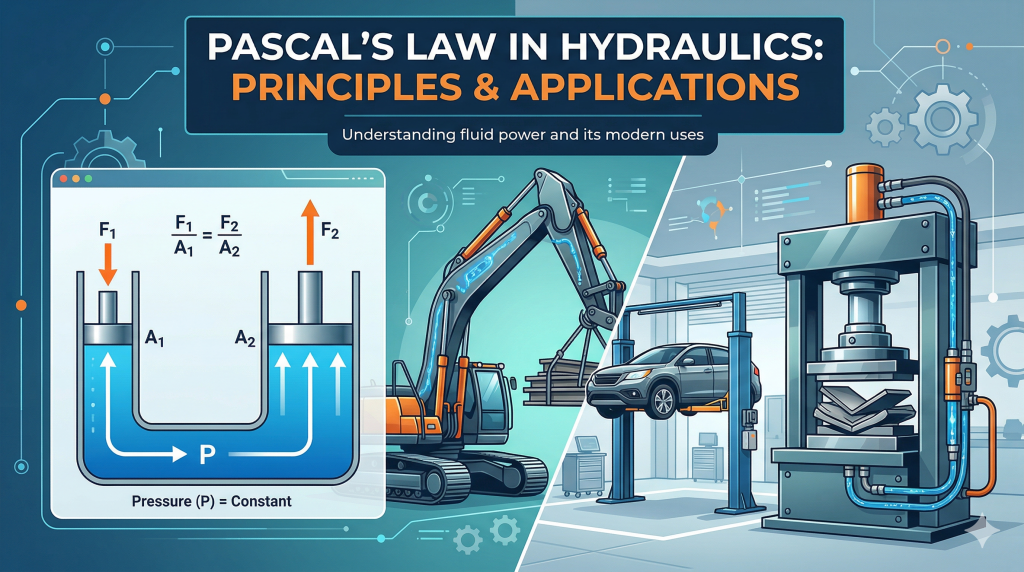
The formal, modern definition of pascals law states that a pressure change at any point in a confined, incompressible fluid at rest is transmitted equally and undiminished to all points in all directions throughout the entire fluid volume. Furthermore, the force resulting from this uniform pressure acts at precise right angles to the enclosing walls of the container, regardless of the container’s geometric shape or complexity. This revelation completely decoupled the transmission of mechanical force from the physical constraints of rigid linkages, such as gears, levers, pulleys, and chains. Instead of relying on solid metal to push solid metal in a straight line, engineers realized they could use a flexible, shape-shifting medium—a liquid—to transfer kinetic energy through tortuously curved hydraulic lines to multiple isolated locations simultaneously, without any loss of pressure intensity.
The Microscopic and Macroscopic Mechanics of Fluid Pressure
To truly understand why pascals principle holds true across diverse engineering applications, one must examine the molecular behavior of liquids compared to other states of matter. Unlike gases, which consist of widely spaced molecules that can be easily compressed into exponentially smaller volumes, the molecules in a liquid medium are densely packed and practically incompressible. When an external mechanical force is applied to a closed system filled with hydraulic oil, the molecular structure of the fluid cannot absorb the kinetic energy by significantly reducing its overall volume. Instead, the molecules slip and slide past one another, instantaneously transmitting the kinetic energy outward in a chain reaction of molecular collisions.
This microscopic interaction directly results in macroscopic pressure uniformity. If an external mechanical force induces a pressure increase at the inlet valve of a hydraulic system, that exact same pressure increase is felt at the furthest reaches of the hydraulic pipeline, against the elastomer seals of the control valves, and against the hardened steel face of the executing cylinders. It is this absolute preservation of pressure intensity across vast physical distances that allows a central, stationary hydraulic power unit (HPU) to drive multiple independent actuators across a sprawling factory floor, or to power the complex articulating arms of a massive piece of earthmoving equipment from a single diesel-driven pump.
The Mathematics of Fluid Pressure Transmission
To translate pascals law into highly functional mechanical engineering, the principle must be expressed mathematically. The core relationship defining fluid pressure is the ratio of applied force to the surface area over which that force is distributed. This is mathematically represented by a simple yet profound equation.
$P = \frac{F}{A}$
Where:
- $P$ represents the pressure (measured in Pascals in the SI system, where 1 Pa = 1 N/m², or in Pounds per Square Inch (PSI) in the Imperial system).
- $F$ represents the magnitude of the applied mechanical force (measured in Newtons or Pounds).
- $A$ represents the cross-sectional surface area over which the force is evenly distributed (measured in square meters or square inches).
Because pascal’s law strictly dictates that the pressure ($P$) remains absolutely constant throughout the entire enclosed fluid system, the relationship between two distinctly different points within the system (for example, a small input piston and a massive output piston) can be equated directly.
$P_1 = P_2$
Therefore, by substituting the force and area variables into the equated pressure, the governing equation for hydraulic mechanical advantage is derived:
$\frac{F_1}{A_1} = \frac{F_2}{A_2}$
This equation serves as the mathematical engine for all hydraulic mechanical advantage calculations. It demonstrates unequivocally that the force exerted at a secondary point ($F_2$) is directly proportional to the ratio of the surface areas of the two points in the system. By rearranging the equation, engineers can calculate the exact output force generated by any hydraulic actuator:
$F_2 = F_1 \times \left( \frac{A_2}{A_1} \right)$
If the active surface area of the output piston ($A_2$) is substantially larger than the active surface area of the input piston ($A_1$), the output force ($F_2$) will be proportionally amplified, allowing a fraction of input effort to generate monumental output power.
Hydrostatic Pressure and Gravitational Elevation
While external mechanical force generated by pumps is the primary driver of modern industrial hydraulic systems, pascals principle also interacts continuously with the forces of gravity. For a vertical fluid column resting in a uniform gravitational field, the total pressure at the bottom of the system is not exclusively dictated by the input piston; it is also heavily influenced by the sheer weight of the fluid mass sitting above it. The difference in static pressure between two varying elevations within a continuous fluid column is defined by the hydrostatic equation:
$\Delta p = \rho g \Delta h$
Where:
- $\Delta p$ represents the hydrostatic pressure difference between two measurement points.
- $\rho$ represents the specific fluid density (typically measured in kilograms per cubic meter).
- $g$ represents the acceleration due to gravity (approximately 9.81 m/s² on Earth).
- $\Delta h$ represents the difference in vertical elevation (height) between the two points within the fluid column.
This physical reality means that in highly vertical fluid systems—such as deep subterranean artesian wells, municipal water towers, or the hydraulic elevator shafts of modern skyscrapers—the baseline static pressure at the bottom of the system is inherently higher than at the top simply due to the resting mass of the fluid. However, the core tenet of pascal’s law remains completely intact: any additional mechanical pressure applied to the enclosed system will be transmitted equally and undiminished to all points. If a hydraulic pump injects exactly 500 PSI of mechanical pressure into the system, the pressure reading at every single gauge throughout the network, regardless of its baseline hydrostatic elevation, will increase by exactly 500 PSI.
Force Amplification and the Conservation of Energy
The most profound technological and commercial outcome of pascals principle is the concept of force multiplication. This capability is what allows a solitary mechanic to safely lift a two-ton commercial vehicle using a small, hand-operated hydraulic floor jack, or enables a massive excavator to tear through solid granite bedrock with seemingly effortless ease.
Consider a theoretical, frictionless hydraulic circuit containing two linked cylinders fitted with pistons. The input piston (Piston 1) has a small cross-sectional area of exactly 1 square inch. The output piston (Piston 2) has a much larger cross-sectional area of exactly 10 square inches. If a downward mechanical force of 10 pounds is applied to Piston 1, it generates a total system pressure of 10 PSI ($P = 10 \text{ lbs} / 1 \text{ sq in}$). According to pascals law, this 10 PSI of pressure is transmitted instantaneously and undiminished through the hydraulic fluid. When this 10 PSI of fluid pressure acts upon the expansive 10 square inches of Piston 2, the resulting upward mechanical force is an impressive 100 pounds ($F_2 = 10 \text{ PSI} \times 10 \text{ sq in}$). The system has effortlessly achieved an Ideal Mechanical Advantage (IMA) of 10:1, multiplying the input force tenfold.
The Immutable Trade-off: Distance, Volume, and Work
While hydraulic systems can dramatically and efficiently amplify force, they are bound by the fundamental laws of the universe; they cannot violate the laws of thermodynamics, and they cannot create kinetic energy out of a vacuum. The strict conservation of energy dictates that the total work done on the input side of the system ($W_{in}$) must exactly equal the total work done by the output side of the system ($W_{out}$), assuming ideal conditions where friction and thermal losses are negligible. In classical mechanics, work is defined mathematically as force multiplied by the distance moved ($W = F \times D$). Therefore, the equilibrium of work in a hydraulic system is expressed as:
$F_1 \times D_1 = F_2 \times D_2$
Because the output force ($F_2$) is mathematically much larger than the input force ($F_1$), the linear distance that the output piston moves ($D_2$) must be proportionally much smaller than the linear distance the input piston is pushed ($D_1$). This physical relationship can also be thoroughly understood through the conservation of fluid volume. The total volume of fluid displaced by the downward stroke of the input piston ($V_1$) must exactly equal the volume of fluid received by the upward stroke of the output piston ($V_2$). Since the volume of a cylinder is calculated by multiplying its cross-sectional area by its linear distance (stroke), the volumetric relationship is:
$A_1 \times D_1 = A_2 \times D_2$
Returning to the previous 10:1 mechanical advantage example, pushing the small 1-square-inch input piston down by a linear distance of 10 inches will physically displace exactly 10 cubic inches of hydraulic fluid into the system lines. When those 10 cubic inches of fluid arrive at the output cylinder and are spread across the vast 10-square-inch surface area of the output piston, they will raise that massive piston by a linear distance of only 1 inch. Thus, the hydraulic system inherently trades distance for force. This elegant, reliable mechanical exchange is the defining characteristic of heavy-duty actuation, allowing small, high-speed pumps to generate slow, unstoppable force.
| Mathematical Variable | Engineering Description | Formulaic Relationship | Impact in Industrial Hydraulic Design |
| Pressure ($P$) | The intensity of kinetic force distributed over a defined area. | $P = F / A$ | Determines the critical pressure rating required for structural hoses, manifold blocks, and elastomer seals. |
| Force ($F$) | The active mechanical push or pull generated by the physical system. | $F = P \times A$ | Dictates the absolute physical lifting, crushing, or pressing capability of a specific cylinder or actuator. |
| Area ($A$) | The exact cross-sectional surface of the internal piston head. | $A = F / P$ | Sizing cylinder bores correctly is the most critical step for achieving desired payload force profiles. |
| Distance ($D$) | The linear travel of the piston, commonly referred to as the stroke. | $D_2 = (A_1 \times D_1) / A_2$ | Defines the maximum stroke length and operational physical reach of the hydraulic arm, press, or lift. |
| Volume ($V$) | The total volumetric amount of incompressible fluid displaced during a cycle. | $V = A \times D$ | Determines the required volumetric flow rate (GPM or L/min) of the pump to achieve desired actuation speeds. |
Fluid Dynamics: The Critical Medium of Transmission
The entire efficacy of pascal’s law in industrial applications relies completely on the physical and chemical properties of the fluid medium used to transmit the pressure. While the law technically applies to all fluids—a scientific category that includes both liquids and gases—there is a massive, fundamental operational divide between hydraulic systems (which utilize liquids) and pneumatic systems (which utilize gases).
Pneumatic systems operate using highly compressible ambient air or specialized gases. While pneumatic circuits are incredibly useful for low-force, exceptionally high-speed applications (such as automated cardboard packaging lines, robotic assembly grippers, or precision dental drills), the inherent compressibility of gas introduces a severe limitation. When a heavy input force is applied to a pneumatic system, a significant percentage of the initial kinetic energy is entirely consumed by simply compressing the gas molecules closer together before any actual pressure is transmitted to the output actuator. This creates a inherently “spongy,” delayed response, rendering precise payload positioning under varying weight loads nearly impossible without secondary mechanical locking mechanisms.
Hydraulic systems, conversely, utilize highly refined petroleum-based mineral oils, advanced synthetic fluids, or specialized water-glycol fire-resistant mixtures. These specifically formulated liquids are virtually incompressible under normal industrial conditions. While it is technically possible to compress a liquid at a molecular level, it requires astronomical, laboratory-level forces to achieve even a microscopically small reduction in fluid volume. Because the hydraulic fluid does not compress, the energy transfer from the pump to the actuator is immediate, highly rigid, and perfectly predictable. This absolute incompressibility is exactly what allows a massive hydraulic excavator to hold a multi-ton concrete boulder suspended in mid-air with absolute, unwavering stability; the trapped fluid acts as a solid, unbreakable mechanical linkage.
Real-World Fluid Limitations and System Degradation
While pascals principle elegantly describes an ideal, perfectly enclosed theoretical system, real-world mechanical engineering must actively account for chaotic fluid dynamics that constantly challenge this ideal state. Engineers must continuously mitigate several destructive physical phenomena to maintain system integrity.
The concept of Bulk Modulus is critical. This is the scientific measure of a fluid’s inherent resistance to uniform compression. A higher bulk modulus indicates greater fluid stiffness. Engineers must meticulously select fluids with appropriate bulk modulus ratings to prevent high-pressure systems from exhibiting slight elastic behaviors, which can severely degrade precision in robotic or aerospace applications. Furthermore, the introduction of entrained air into the fluid is disastrous. If microscopic air bubbles are drawn into the hydraulic oil through a loose fitting, the fluid mixture immediately becomes compressible. This destroys the foundational efficiency of pascals law, causing sluggish, unpredictable actuator response. Worse still, when these highly pressurized air bubbles pass through a valve and violently collapse, they cause micro-explosions that tear metal away from internal components—a highly destructive phenomenon known as cavitation.
Finally, viscosity and thermal degradation pose constant threats. As hydraulic systems operate, forcing fluid through narrow valve orifices and restrictive hoses, they generate massive amounts of heat due to internal fluid friction. If the fluid becomes too hot, its kinematic viscosity drops rapidly, causing the oil to thin out and lose its lubricating properties. This extreme thinning leads to internal fluid leakage across microscopic clearances between valve spools and piston seals, utterly compromising the rigidly “enclosed” nature of the system required by pascals law to maintain pressure.
Transforming Physics into Industry: The Carehyd Ecosystem
A profound theoretical understanding of fluid pressure mathematics is rendered practically meaningless without the physical mechanical components designed to harness it. Since its founding in 1998, Carehyd has actively bridged the wide gap between scientific theory and brutal industrial application, engineering a comprehensive, global ecosystem of fluid power components designed specifically to generate, regulate, and execute hydraulic force. Operating from a sprawling, state-of-the-art manufacturing facility located at No. 4, Shuikou Street in the Huicheng District of Huizhou City, Guangdong Province, China, Carehyd serves as an elite strategic engineering partner to critical industries across more than 130 countries. The company has built a reputation on providing independent, catalog-agnostic hydraulic solutions, prioritizing exact client engineering needs over pushing a single manufacturer’s proprietary ecosystem.
In a typical, highly engineered Carehyd system, pascals principle is actively generated, controlled, and deployed by three primary phases of heavy equipment:
Phase 1: Power Generation and Fluid Motivation (Hydraulic Pumps)
It is a highly common misconception among laypersons that hydraulic pumps inherently “create” pressure. In strict reality, pumps merely generate continuous volumetric fluid flow. System pressure is only created when that fluid flow meets mechanical resistance—such as a heavy physical payload pushing back on a cylinder rod, or a deliberate fluid restriction designed into a control valve. As the mechanical pump aggressively forces fluid into the sealed, enclosed system, pressure builds uniformly and equally throughout the entire circuit according to pascal’s law. Carehyd supplies a vast, meticulously engineered array of high-performance pumps to perfectly match specific industrial flow and pressure requirements.
The foundation of their catalog includes robust Gear Pumps. Carehyd provides extensive, high-quality replacements for ubiquitous global models, such as the Bosch Rexroth AZPF external gear series and Parker Hannifin PGP series. Built with high-pressure aluminum centers and cast-iron end plates, these pumps are the rugged, indestructible workhorses of the industry, ideal for continuous fluid transfer and robust pressure generation in exceptionally harsh environments. For applications requiring exponentially higher pressures, Carehyd provides Piston Pumps, available in both axial and variable displacement architectures (such as the Rexroth A10VSO series). These complex pumps utilize a rotating barrel of finely machined pistons to draw in and expel fluid, making them essential for applications requiring immense, sustained force, such as heavy metal stamping presses. Finally, Vane Pumps (including replacements for Parker Denison T6, Yuken PV2R, and Atos PFE-51 series) are deployed in industrial environments where extreme noise reduction, smooth fluid delivery, and excellent volumetric efficiency are paramount.
Phase 2: Directional Routing and Pressure Regulation (Hydraulic Valves)
If the pump serves as the beating heart of the hydraulic system, the valves serve as the highly intelligent brain. Because pascals law dictates that pressure will relentlessly equalize throughout an open, unobstructed circuit, valves are strictly required to intentionally partition the circuit, directing high-pressure fluid flow to specific actuators and managing maximum pressure thresholds to prevent catastrophic explosions.
Carehyd provides standard Relief Valves that protect the structural integrity of the system by automatically opening and dumping pressurized fluid safely back to the reservoir if the pressure exceeds predetermined safe mechanical limits. However, their true expertise lies in Proportional and Servo Valves. Carehyd utilizes highly advanced electro-hydraulic servo valves (including models compatible with Moog, Eaton, and Yuken architectures) to provide microscopic, computer-controlled metering over fluid flow. By precisely manipulating the exact volume and pressure of fluid entering a cylinder, these advanced valves dictate the exact speed, acceleration, and terminal force of the actuator, enabling millimeter-level positioning in automated robotics and manufacturing lines.
Phase 3: Mechanical Execution and Work (Hydraulic Actuators)
The final, physical stage of the hydraulic circuit is where fluid pressure is finally converted back into kinetic mechanical force via hydraulic cylinders or hydraulic rotary motors. Linear Actuators, commonly known as cylinders, rely directly and entirely on the $F = P \times A$ mathematical formula. High-pressure fluid enters the completely sealed cylinder chamber, applying massive force directly against the flat piston head to violently extend or retract a heavy physical load. Conversely, Rotary Actuators, or hydraulic motors, use uniform fluid pressure to drive internal gears, sliding vanes, or angled pistons in a continuous, relentless rotational motion. These High-Torque, Low-Speed (HTLS) motors convert hydraulic fluid energy into immense rotational torque, capable of turning massive cement kilns or industrial rock crushers that would easily shatter the shaft of a standard electric motor.
| Carehyd Component Category | Specific Function in the Context of Pascal’s Law | Typical Industrial Carehyd Solutions |
| Hydraulic Pumps | Forces incompressible liquid into a confined spatial volume, initiating the exact conditions required for pressure build-up. | Rexroth/Parker replacement Gear Pumps, Axial Piston Pumps (A10VSO), High-efficiency Yuken Vane Pumps. |
| Manifolds & Valves | Segregates the confined fluid physically, allowing operators to isolate pressure zones and direct kinetic force to specific areas. | Proportional directional valves, Zero-drift medical locking valves, Pressure relief safety modules. |
| Linear Cylinders | The physical, real-world manifestation of $F = P \times A$. Converts static fluid pressure into linear mechanical push/pull force. | Heavy-duty construction/earthmoving cylinders, 316L Stainless Steel hygienic actuators for pharmaceuticals. |
| Hydraulic Motors | Converts uniform fluid pressure into unstoppable rotational torque for driving massive, continuous-duty machinery. | High-Torque Low-Speed (HTLS) motors for rock crushers, Casappa/Linde continuous duty motors. |
Fluid Dynamics: The Critical Medium of Transmission
The entire efficacy of pascal’s law in industrial applications relies completely on the physical and chemical properties of the fluid medium used to transmit the pressure. While the law technically applies to all fluids—a scientific category that includes both liquids and gases—there is a massive, fundamental operational divide between hydraulic systems (which utilize liquids) and pneumatic systems (which utilize gases).
Pneumatic systems operate using highly compressible ambient air or specialized gases. While pneumatic circuits are incredibly useful for low-force, exceptionally high-speed applications (such as automated cardboard packaging lines, robotic assembly grippers, or precision dental drills), the inherent compressibility of gas introduces a severe limitation. When a heavy input force is applied to a pneumatic system, a significant percentage of the initial kinetic energy is entirely consumed by simply compressing the gas molecules closer together before any actual pressure is transmitted to the output actuator. This creates a inherently “spongy,” delayed response, rendering precise payload positioning under varying weight loads nearly impossible without secondary mechanical locking mechanisms.
Hydraulic systems, conversely, utilize highly refined petroleum-based mineral oils, advanced synthetic fluids, or specialized water-glycol fire-resistant mixtures. These specifically formulated liquids are virtually incompressible under normal industrial conditions. While it is technically possible to compress a liquid at a molecular level, it requires astronomical, laboratory-level forces to achieve even a microscopically small reduction in fluid volume. Because the hydraulic fluid does not compress, the energy transfer from the pump to the actuator is immediate, highly rigid, and perfectly predictable. This absolute incompressibility is exactly what allows a massive hydraulic excavator to hold a multi-ton concrete boulder suspended in mid-air with absolute, unwavering stability; the trapped fluid acts as a solid, unbreakable mechanical linkage.
Real-World Fluid Limitations and System Degradation
While pascals principle elegantly describes an ideal, perfectly enclosed theoretical system, real-world mechanical engineering must actively account for chaotic fluid dynamics that constantly challenge this ideal state. Engineers must continuously mitigate several destructive physical phenomena to maintain system integrity.
The concept of Bulk Modulus is critical. This is the scientific measure of a fluid’s inherent resistance to uniform compression. A higher bulk modulus indicates greater fluid stiffness. Engineers must meticulously select fluids with appropriate bulk modulus ratings to prevent high-pressure systems from exhibiting slight elastic behaviors, which can severely degrade precision in robotic or aerospace applications. Furthermore, the introduction of entrained air into the fluid is disastrous. If microscopic air bubbles are drawn into the hydraulic oil through a loose fitting, the fluid mixture immediately becomes compressible. This destroys the foundational efficiency of pascals law, causing sluggish, unpredictable actuator response. Worse still, when these highly pressurized air bubbles pass through a valve and violently collapse, they cause micro-explosions that tear metal away from internal components—a highly destructive phenomenon known as cavitation.
Finally, viscosity and thermal degradation pose constant threats. As hydraulic systems operate, forcing fluid through narrow valve orifices and restrictive hoses, they generate massive amounts of heat due to internal fluid friction. If the fluid becomes too hot, its kinematic viscosity drops rapidly, causing the oil to thin out and lose its lubricating properties. This extreme thinning leads to internal fluid leakage across microscopic clearances between valve spools and piston seals, utterly compromising the rigidly “enclosed” nature of the system required by pascals law to maintain pressure.
Transforming Physics into Industry: The Carehyd Ecosystem
A profound theoretical understanding of fluid pressure mathematics is rendered practically meaningless without the physical mechanical components designed to harness it. Since its founding in 1998, Carehyd has actively bridged the wide gap between scientific theory and brutal industrial application, engineering a comprehensive, global ecosystem of fluid power components designed specifically to generate, regulate, and execute hydraulic force. Operating from a sprawling, state-of-the-art manufacturing facility located at No. 4, Shuikou Street in the Huicheng District of Huizhou City, Guangdong Province, China, Carehyd serves as an elite strategic engineering partner to critical industries across more than 130 countries. The company has built a reputation on providing independent, catalog-agnostic hydraulic solutions, prioritizing exact client engineering needs over pushing a single manufacturer’s proprietary ecosystem.
In a typical, highly engineered Carehyd system, pascals principle is actively generated, controlled, and deployed by three primary phases of heavy equipment:
Phase 1: Power Generation and Fluid Motivation (Hydraulic Pumps)
It is a highly common misconception among laypersons that hydraulic pumps inherently “create” pressure. In strict reality, pumps merely generate continuous volumetric fluid flow. System pressure is only created when that fluid flow meets mechanical resistance—such as a heavy physical payload pushing back on a cylinder rod, or a deliberate fluid restriction designed into a control valve. As the mechanical pump aggressively forces fluid into the sealed, enclosed system, pressure builds uniformly and equally throughout the entire circuit according to pascal’s law. Carehyd supplies a vast, meticulously engineered array of high-performance pumps to perfectly match specific industrial flow and pressure requirements.
The foundation of their catalog includes robust Gear Pumps. Carehyd provides extensive, high-quality replacements for ubiquitous global models, such as the Bosch Rexroth AZPF external gear series and Parker Hannifin PGP series. Built with high-pressure aluminum centers and cast-iron end plates, these pumps are the rugged, indestructible workhorses of the industry, ideal for continuous fluid transfer and robust pressure generation in exceptionally harsh environments. For applications requiring exponentially higher pressures, Carehyd provides Piston Pumps, available in both axial and variable displacement architectures (such as the Rexroth A10VSO series). These complex pumps utilize a rotating barrel of finely machined pistons to draw in and expel fluid, making them essential for applications requiring immense, sustained force, such as heavy metal stamping presses. Finally, Vane Pumps (including replacements for Parker Denison T6, Yuken PV2R, and Atos PFE-51 series) are deployed in industrial environments where extreme noise reduction, smooth fluid delivery, and excellent volumetric efficiency are paramount.
Phase 2: Directional Routing and Pressure Regulation (Hydraulic Valves)
If the pump serves as the beating heart of the hydraulic system, the valves serve as the highly intelligent brain. Because pascals law dictates that pressure will relentlessly equalize throughout an open, unobstructed circuit, valves are strictly required to intentionally partition the circuit, directing high-pressure fluid flow to specific actuators and managing maximum pressure thresholds to prevent catastrophic explosions.
Carehyd provides standard Relief Valves that protect the structural integrity of the system by automatically opening and dumping pressurized fluid safely back to the reservoir if the pressure exceeds predetermined safe mechanical limits. However, their true expertise lies in Proportional and Servo Valves. Carehyd utilizes highly advanced electro-hydraulic servo valves (including models compatible with Moog, Eaton, and Yuken architectures) to provide microscopic, computer-controlled metering over fluid flow. By precisely manipulating the exact volume and pressure of fluid entering a cylinder, these advanced valves dictate the exact speed, acceleration, and terminal force of the actuator, enabling millimeter-level positioning in automated robotics and manufacturing lines.
Phase 3: Mechanical Execution and Work (Hydraulic Actuators)
The final, physical stage of the hydraulic circuit is where fluid pressure is finally converted back into kinetic mechanical force via hydraulic cylinders or hydraulic rotary motors. Linear Actuators, commonly known as cylinders, rely directly and entirely on the $F = P \times A$ mathematical formula. High-pressure fluid enters the completely sealed cylinder chamber, applying massive force directly against the flat piston head to violently extend or retract a heavy physical load. Conversely, Rotary Actuators, or hydraulic motors, use uniform fluid pressure to drive internal gears, sliding vanes, or angled pistons in a continuous, relentless rotational motion. These High-Torque, Low-Speed (HTLS) motors convert hydraulic fluid energy into immense rotational torque, capable of turning massive cement kilns or industrial rock crushers that would easily shatter the shaft of a standard electric motor.
| Carehyd Component Category | Specific Function in the Context of Pascal’s Law | Typical Industrial Carehyd Solutions |
| Hydraulic Pumps | Forces incompressible liquid into a confined spatial volume, initiating the exact conditions required for pressure build-up. | Rexroth/Parker replacement Gear Pumps, Axial Piston Pumps (A10VSO), High-efficiency Yuken Vane Pumps. |
| Manifolds & Valves | Segregates the confined fluid physically, allowing operators to isolate pressure zones and direct kinetic force to specific areas. | Proportional directional valves, Zero-drift medical locking valves, Pressure relief safety modules. |
| Linear Cylinders | The physical, real-world manifestation of $F = P \times A$. Converts static fluid pressure into linear mechanical push/pull force. | Heavy-duty construction/earthmoving cylinders, 316L Stainless Steel hygienic actuators for pharmaceuticals. |
| Hydraulic Motors | Converts uniform fluid pressure into unstoppable rotational torque for driving massive, continuous-duty machinery. | High-Torque Low-Speed (HTLS) motors for rock crushers, Casappa/Linde continuous duty motors. |
Fluid Dynamics: The Critical Medium of Transmission
The entire efficacy of pascal’s law in industrial applications relies completely on the physical and chemical properties of the fluid medium used to transmit the pressure. While the law technically applies to all fluids—a scientific category that includes both liquids and gases—there is a massive, fundamental operational divide between hydraulic systems (which utilize liquids) and pneumatic systems (which utilize gases).
Pneumatic systems operate using highly compressible ambient air or specialized gases. While pneumatic circuits are incredibly useful for low-force, exceptionally high-speed applications (such as automated cardboard packaging lines, robotic assembly grippers, or precision dental drills), the inherent compressibility of gas introduces a severe limitation. When a heavy input force is applied to a pneumatic system, a significant percentage of the initial kinetic energy is entirely consumed by simply compressing the gas molecules closer together before any actual pressure is transmitted to the output actuator. This creates a inherently “spongy,” delayed response, rendering precise payload positioning under varying weight loads nearly impossible without secondary mechanical locking mechanisms.
Hydraulic systems, conversely, utilize highly refined petroleum-based mineral oils, advanced synthetic fluids, or specialized water-glycol fire-resistant mixtures. These specifically formulated liquids are virtually incompressible under normal industrial conditions. While it is technically possible to compress a liquid at a molecular level, it requires astronomical, laboratory-level forces to achieve even a microscopically small reduction in fluid volume. Because the hydraulic fluid does not compress, the energy transfer from the pump to the actuator is immediate, highly rigid, and perfectly predictable. This absolute incompressibility is exactly what allows a massive hydraulic excavator to hold a multi-ton concrete boulder suspended in mid-air with absolute, unwavering stability; the trapped fluid acts as a solid, unbreakable mechanical linkage.
Real-World Fluid Limitations and System Degradation
While pascals principle elegantly describes an ideal, perfectly enclosed theoretical system, real-world mechanical engineering must actively account for chaotic fluid dynamics that constantly challenge this ideal state. Engineers must continuously mitigate several destructive physical phenomena to maintain system integrity.
The concept of Bulk Modulus is critical. This is the scientific measure of a fluid’s inherent resistance to uniform compression. A higher bulk modulus indicates greater fluid stiffness. Engineers must meticulously select fluids with appropriate bulk modulus ratings to prevent high-pressure systems from exhibiting slight elastic behaviors, which can severely degrade precision in robotic or aerospace applications. Furthermore, the introduction of entrained air into the fluid is disastrous. If microscopic air bubbles are drawn into the hydraulic oil through a loose fitting, the fluid mixture immediately becomes compressible. This destroys the foundational efficiency of pascals law, causing sluggish, unpredictable actuator response. Worse still, when these highly pressurized air bubbles pass through a valve and violently collapse, they cause micro-explosions that tear metal away from internal components—a highly destructive phenomenon known as cavitation.
Finally, viscosity and thermal degradation pose constant threats. As hydraulic systems operate, forcing fluid through narrow valve orifices and restrictive hoses, they generate massive amounts of heat due to internal fluid friction. If the fluid becomes too hot, its kinematic viscosity drops rapidly, causing the oil to thin out and lose its lubricating properties. This extreme thinning leads to internal fluid leakage across microscopic clearances between valve spools and piston seals, utterly compromising the rigidly “enclosed” nature of the system required by pascals law to maintain pressure.
Transforming Physics into Industry: The Carehyd Ecosystem
A profound theoretical understanding of fluid pressure mathematics is rendered practically meaningless without the physical mechanical components designed to harness it. Since its founding in 1998, Carehyd has actively bridged the wide gap between scientific theory and brutal industrial application, engineering a comprehensive, global ecosystem of fluid power components designed specifically to generate, regulate, and execute hydraulic force. Operating from a sprawling, state-of-the-art manufacturing facility located at No. 4, Shuikou Street in the Huicheng District of Huizhou City, Guangdong Province, China, Carehyd serves as an elite strategic engineering partner to critical industries across more than 130 countries. The company has built a reputation on providing independent, catalog-agnostic hydraulic solutions, prioritizing exact client engineering needs over pushing a single manufacturer’s proprietary ecosystem.
In a typical, highly engineered Carehyd system, pascals principle is actively generated, controlled, and deployed by three primary phases of heavy equipment:
Phase 1: Power Generation and Fluid Motivation (Hydraulic Pumps)
It is a highly common misconception among laypersons that hydraulic pumps inherently “create” pressure. In strict reality, pumps merely generate continuous volumetric fluid flow. System pressure is only created when that fluid flow meets mechanical resistance—such as a heavy physical payload pushing back on a cylinder rod, or a deliberate fluid restriction designed into a control valve. As the mechanical pump aggressively forces fluid into the sealed, enclosed system, pressure builds uniformly and equally throughout the entire circuit according to pascal’s law. Carehyd supplies a vast, meticulously engineered array of high-performance pumps to perfectly match specific industrial flow and pressure requirements.
The foundation of their catalog includes robust Gear Pumps. Carehyd provides extensive, high-quality replacements for ubiquitous global models, such as the Bosch Rexroth AZPF external gear series and Parker Hannifin PGP series. Built with high-pressure aluminum centers and cast-iron end plates, these pumps are the rugged, indestructible workhorses of the industry, ideal for continuous fluid transfer and robust pressure generation in exceptionally harsh environments. For applications requiring exponentially higher pressures, Carehyd provides Piston Pumps, available in both axial and variable displacement architectures (such as the Rexroth A10VSO series). These complex pumps utilize a rotating barrel of finely machined pistons to draw in and expel fluid, making them essential for applications requiring immense, sustained force, such as heavy metal stamping presses. Finally, Vane Pumps (including replacements for Parker Denison T6, Yuken PV2R, and Atos PFE-51 series) are deployed in industrial environments where extreme noise reduction, smooth fluid delivery, and excellent volumetric efficiency are paramount.
Phase 2: Directional Routing and Pressure Regulation (Hydraulic Valves)
If the pump serves as the beating heart of the hydraulic system, the valves serve as the highly intelligent brain. Because pascals law dictates that pressure will relentlessly equalize throughout an open, unobstructed circuit, valves are strictly required to intentionally partition the circuit, directing high-pressure fluid flow to specific actuators and managing maximum pressure thresholds to prevent catastrophic explosions.
Carehyd provides standard Relief Valves that protect the structural integrity of the system by automatically opening and dumping pressurized fluid safely back to the reservoir if the pressure exceeds predetermined safe mechanical limits. However, their true expertise lies in Proportional and Servo Valves. Carehyd utilizes highly advanced electro-hydraulic servo valves (including models compatible with Moog, Eaton, and Yuken architectures) to provide microscopic, computer-controlled metering over fluid flow. By precisely manipulating the exact volume and pressure of fluid entering a cylinder, these advanced valves dictate the exact speed, acceleration, and terminal force of the actuator, enabling millimeter-level positioning in automated robotics and manufacturing lines.
Phase 3: Mechanical Execution and Work (Hydraulic Actuators)
The final, physical stage of the hydraulic circuit is where fluid pressure is finally converted back into kinetic mechanical force via hydraulic cylinders or hydraulic rotary motors. Linear Actuators, commonly known as cylinders, rely directly and entirely on the $F = P \times A$ mathematical formula. High-pressure fluid enters the completely sealed cylinder chamber, applying massive force directly against the flat piston head to violently extend or retract a heavy physical load. Conversely, Rotary Actuators, or hydraulic motors, use uniform fluid pressure to drive internal gears, sliding vanes, or angled pistons in a continuous, relentless rotational motion. These High-Torque, Low-Speed (HTLS) motors convert hydraulic fluid energy into immense rotational torque, capable of turning massive cement kilns or industrial rock crushers that would easily shatter the shaft of a standard electric motor.
| Carehyd Component Category | Specific Function in the Context of Pascal’s Law | Typical Industrial Carehyd Solutions |
| Hydraulic Pumps | Forces incompressible liquid into a confined spatial volume, initiating the exact conditions required for pressure build-up. | Rexroth/Parker replacement Gear Pumps, Axial Piston Pumps (A10VSO), High-efficiency Yuken Vane Pumps. |
| Manifolds & Valves | Segregates the confined fluid physically, allowing operators to isolate pressure zones and direct kinetic force to specific areas. | Proportional directional valves, Zero-drift medical locking valves, Pressure relief safety modules. |
| Linear Cylinders | The physical, real-world manifestation of $F = P \times A$. Converts static fluid pressure into linear mechanical push/pull force. | Heavy-duty construction/earthmoving cylinders, 316L Stainless Steel hygienic actuators for pharmaceuticals. |
| Hydraulic Motors | Converts uniform fluid pressure into unstoppable rotational torque for driving massive, continuous-duty machinery. | High-Torque Low-Speed (HTLS) motors for rock crushers, Casappa/Linde continuous duty motors. |
Macro-Industrial Applications: Brute Force and Heavy Infrastructure Engineering
The mathematical ability to multiply force via pascals principle is the absolute bedrock of heavy global industry. Without the deployment of fluid power, modern civil infrastructure, subterranean mining, and mass automotive manufacturing would be physically impossible. Carehyd has spent decades engineering specialized, heavy-duty solutions to ensure that hydraulic systems survive the brutal, unforgiving realities of these specific sectors, where machines operate 24/7/365 in environments utterly saturated with abrasive dust, massive kinetic shock loads, and extreme thermal variations.
Construction and Civil Infrastructure
Modern commercial construction equipment—massive excavators, bulldozers, towering cranes, and pile drivers—relies entirely on hydraulic cylinders to manipulate multi-ton payloads against the forces of gravity. The unpredictable, chaotic nature of outdoor job sites requires hydraulic systems that offer both immense brute power and delicate, surgical finesse.
Carehyd masterfully addresses these intense demands through the implementation of advanced load-sensing technology and proportional valve systems. Traditional, rudimentary construction hydraulics run diesel-driven pumps at maximum flow continuously, dumping all excess, unused pressure over a relief valve—a massive, costly waste of diesel fuel and mechanical energy. Carehyd’s “smart” load-sensing systems dynamically and instantly adjust the hydraulic pump’s output to produce only the exact pressure and fluid flow demanded by the operator’s joystick at that specific millisecond. This allows a skilled excavator operator to lift a heavy load, swing the massive boom, and travel across the dirt simultaneously without experiencing sudden pressure drops, creating a digging cycle that is faster, exceptionally smoother, and highly fuel-efficient. Furthermore, critical safety is ensured through fail-safe counterbalance valves, also known as pilot-operated check valves, which are integrated directly into the steel body of the cylinders. Should a high-pressure hydraulic hose suddenly burst due to abrasion, these valves instantly sense the pressure loss and lock the trapped fluid within the cylinder. Utilizing pascals law, the trapped fluid maintains a solid, unbreakable column of oil that prevents a 50-ton suspended steel beam or aerial operator basket from crashing violently to the ground.
Materials and Resources: Mining, Aggregates, and Paper Pulp
In the harsh materials sector, which includes deep-shaft mining, cement production, and paper pulp processing, machinery is subjected to relentless, grinding abrasion and catastrophic vibration that destroys lesser equipment. Standard electric motors and mechanical gearboxes often shatter their internal teeth or completely stall when faced with the immense friction and resistance of a fully loaded ore crusher. Hydraulic systems excel in these brutal environments precisely because they are inherently “stall-proof.” A Carehyd High-Torque, Low-Speed (HTLS) hydraulic motor can output exactly 100% of its maximum rated torque at 0 RPM indefinitely, easily overcoming massive breakaway friction to get a 1000-ton load moving without ever burning out an electrical coil.
Pascal’s principle is also ingeniously utilized in Carehyd’s life-saving “Tramp Relief” systems designed specifically for massive cone crushers. In standard operation, hydraulic cylinders hold the heavy grinding bowl down to crush rock. If an uncrushable piece of solid steel—known as “tramp,” such as a broken excavator tooth or drill bit—accidentally enters the rock crusher, the immense mechanical stress instantly spikes the hydraulic pressure inside the hold-down cylinders to dangerous levels. A highly sensitive pressure-relief system senses this instantaneous spike and redirects the pressurized fluid into a nitrogen-charged hydraulic accumulator. This action allows the heavy grinding bowl to lift dynamically, pass the destructive steel object without shattering the machine, and then use the stored accumulator pressure to immediately reseat the bowl within seconds—all without ever stopping the continuous 24/7 mining process. To survive the highly corrosive “white liquor” chemicals used in paper pulp processing, Carehyd completely abandons standard steel, instead manufacturing specialized “Wet-End” cylinders entirely from 316L Stainless Steel, fitted with chemically resistant Viton® elastomer seals.
The Global Automotive Manufacturing Sector
The global automotive manufacturing industry demands a level of high-tempo production efficiency and zero-downtime reliability that sets the benchmark for worldwide automation. Automotive stamping presses utilize immense, building-sized hydraulic cylinders to generate the thousands of tons of force required to cold-form thick steel sheets into complex car body panels in a fraction of a second. Electric servo-actuators simply cannot economically or physically generate this level of instantaneous brute force; hydraulics remain utterly irreplaceable.
Carehyd extensively supports these high-stakes operations by supplying high-flow main pumps and high-response servo valves that deliver perfectly repeatable force profiles, ensuring every stamped panel is dimensionally identical. Beyond raw stamping, compact, highly localized hydraulic power units (HPUs) provide the extreme-stiffness clamping necessary for robotic body-in-white (BIW) welding stations. Because hydraulic fluid is incompressible, these clamps hold the metal chassis with zero microscopic flex, ensuring structural integrity across millions of rapid welding cycles. In final assembly, Carehyd provides precisely synchronized hydraulic scissor lifts designed to manage the delicate “chassis marriage” process, where the heavy powertrain is seamlessly lifted and bolted directly into the suspended vehicle body.
Energy and Utilities: Sustaining the Grid
The energy and public utilities sector serves as the 24/7/365 backbone of modern society; in this realm, equipment failure translates directly to catastrophic blackouts or pipeline ruptures. Carehyd engineers solutions for these sectors based on extreme asset longevity, designing components expected to operate flawlessly for 20 to 50 years in deeply hostile environments.
In the renewable energy sector, hydraulic power density is unmatched. Inside the cramped, highly restrictive nacelle of a modern wind turbine, Carehyd provides compact hydraulic pitch control systems. These systems precisely adjust the angle of massive 100-meter fiberglass blades to maximize aerodynamic efficiency. Crucially, they utilize pascals law as a mandatory safety mechanism. By storing pressurized hydraulic fluid inside large accumulators, the system maintains a “fail-safe” capability. Even if the turbine completely loses all electrical grid power during a violent hurricane, the stored hydraulic pressure is instantly released to automatically “feather” the blades out of the wind, preventing the turbine from spinning out of control and destroying itself. In traditional hydropower and thermal power generation, highly precise hydraulic governor systems act as the “cruise control” for the power grid. Using high-response servo-valves, these hydraulic systems make microscopic adjustments to the massive flow of steam, gas, or water entering the turbines, ensuring the massive generators hold a perfectly stable 50 or 60 Hz rotational speed, which is absolutely vital for grid synchronization.
Micro-Industrial Applications: Precision, Cleanliness, and Advanced Automation
While pascal’s law is most famous in the public consciousness for multiplying massive force in construction equipment, its unique ability to transmit pressure uniformly also allows for unprecedented, microscopic motion control. By using high-resolution digital electronics to precisely meter fluid flow, modern hydraulic systems can achieve micron-level positioning and whisper-quiet operation. Carehyd has pioneered advanced solutions for highly regulated, sterile clean-room environments where traditional, leak-prone hydraulics were historically strictly prohibited.
Healthcare, Surgical Devices, and Pharmaceutics
In a clinical hospital setting, industrial speed and brute force are entirely secondary to the mandates of absolute patient safety, operational silence, and perfectly smooth articulation. Standard electric leadscrews, which are commonly used in cheap medical beds, can be easily “back-driven” or forced backward under heavy bariatric weight loads, and they frequently emit high-frequency whining noises that distract surgeons. Carehyd’s medical-grade hydraulic systems completely eliminate these severe issues. By employing specialized internal screw pumps and proportional valving, Carehyd delivers a “whisper-quiet,” perfectly fluid motion that provides smooth starts and stops, protecting the delicate precision of a surgeon and the comfort of the patient.
Pascal’s law is leveraged directly for maximum safety through the use of Carehyd’s “zero-drift” locking valves. When electrical power is removed from the system, these valves hermetically seal the hydraulic fluid inside the actuator cylinder. Because the trapped liquid is scientifically incompressible, it immediately forms an unyielding physical pillar of fluid, ensuring that a bariatric patient lift carrying 500kg, or a critical surgical table holding a patient mid-operation, will never sag, slip, or drift downward.
Furthermore, the highly specific demands of Diagnostic Imaging (MRI) applications showcase the supreme flexibility of fluid power. MRI machines generate immense magnetic fields that turn any ferrous metal into a lethal projectile. Carehyd engineers completely non-ferrous, MR-conditional hydraulic actuators manufactured exclusively from non-magnetic 316L stainless steel, pure titanium, and advanced polymers. The heavy hydraulic pump and electric motor are stationed safely 20 meters away in a shielded control room, while flexible, non-metallic hoses transmit fluid pressure to the actuator operating the patient table deep inside the magnetic MRI bore—an engineering feat that is physically impossible to achieve with a standard copper-wound electric motor. In the highly regulated pharmaceutical sector, Carehyd provides crevice-free, low-Ra polished 316L stainless steel cylinders that meet stringent FDA and Good Manufacturing Practice (GMP) compliance, capable of withstanding aggressive Steam-In-Place (SIP) sterilization and delivering the extreme pressures (up to 40,000 psi) required for creating nano-emulsions.
Consumer Goods, Plastics, and High-Speed Packaging
The global consumer goods industry—tasked with producing everything from thin-walled plastic beverage bottles to perfectly sealed blister-packed pharmaceuticals—operates at blistering, 24/7 continuous speeds where success is measured in milliseconds. Carehyd addresses the strict “Consumer Goods Mandate” of high speed, total hygiene, and relentless uptime through highly specialized fluid power designs.
For high-volume plastic injection molding, massive, instantaneous bursts of speed are strictly required to fill complex mold cavities with molten plastic before the material can cool and harden. Carehyd achieves this impossible velocity by using hydraulic accumulators. These pressure vessels pre-store hydraulic fluid against a highly compressed barrier of nitrogen gas. When the injection directional valve opens, the accumulator releases the stored pressurized fluid instantaneously, delivering a violent velocity and flow rate that is physically impossible to achieve with a standard mechanical pump alone. To meet stringent hygiene standards in direct-contact food and beverage processing, Carehyd completely abandons standard hydraulic oils, utilizing NSF H1 food-grade fluids and manufacturing cylinders from polished stainless steel capable of surviving daily, highly caustic chemical washdowns without corroding.
Next-Generation Battery Production (Lithium-Ion)
The manufacturing of next-generation lithium-ion battery cells is described by engineers as a “game of microns.” The most absolutely critical step in this process is electrode calendering, which involves using massive rollers to press delicate anode and cathode materials to an exact, uniform thickness. Standard electric actuators lack the unyielding structural stiffness required to maintain this pressure. Carehyd’s advanced servo-hydraulic systems provide massive rolling force while utilizing highly complex closed-loop digital controllers. High-resolution pressure transducers read the hydraulic fluid pressure thousands of times per second, instructing a micro-processor-controlled servo-valve to add or release microscopic, teardrop amounts of fluid. This incredibly rapid adjustment loop maintains the exact physical pressing force to within a fraction of a single percent, guaranteeing perfectly consistent electrochemical density across miles of the battery web. Similarly, hydraulic motors provide perfectly smooth, cog-free torque for Roll-to-Roll (R2R) web tensioning, preventing delicate copper foils from tearing or stretching.
The Future of Fluid Power: Sustainability, Efficiency, and Convergence
Despite its unmatched power density and reliability, traditional fluid power technology has faced valid, increasing criticism regarding its poor energy efficiency. Legacy hydraulic systems that run constant-speed diesel or electric pumps waste enormous amounts of energy by continuously dumping bypassed, unused fluid over relief valves—kinetic energy that is ultimately converted into damaging thermal heat. As global manufacturing industries shift aggressively toward rapid decarbonization and strictly regulated energy limits, optimizing the application of pascals principle is paramount to the survival of the industry.
The Rise of Energy-Saving Servo-Pumps
Carehyd is actively driving the modernization of global fluid power by completely abandoning outdated, constantly-running pump architectures in favor of highly intelligent Energy-Saving Servo-Pump systems. In these advanced mechatronic architectures, a digitally controlled electric servo motor drives the hydraulic pump. The motor’s rotational speed is dictated entirely by a digital controller that senses the exact, real-time pressure and flow requirements of the machine. When the machine enters an idle phase—such as during the multi-second cooling phase of a plastic injection mold—the servo motor drops immediately to zero RPM. It only consumes electricity when physical motion or pressure is actively demanded by the system. This highly responsive “power-on-demand” approach behaves exactly like an efficient electric drive, slashing total electrical energy consumption by an astounding 50% to 70% and drastically lowering the total cost of ownership for massive factory operations.
Electro-Hydrostatic Actuators (EHA) and the “Clean-Tech” Revolution
To aggressively combat the persistent, decades-old industrial myth that hydraulics are inherently “dirty” and prone to leaking hoses, the cutting-edge of the industry is moving rapidly toward Electrohydrostatic Actuation (EHA). An EHA is a highly advanced, “black box” self-contained unit that physically integrates the electric servo motor, the hydraulic pump, a small fluid reservoir, and the actuating cylinder into a single, compact, factory-sealed component.
In an EHA system, there are absolutely no external hydraulic hoses, no complex pipe networks, and no massive central power units required. Power is supplied to the unit via standard electrical cables, but the internal physical motion relies entirely on pascals law to amplify the force of the small internal pump. This hybrid convergence technology delivers the absolute cleanliness and easy “plug-and-play” installation of a standard electric actuator, combined perfectly with the immense power density, massive shock resistance, and vital fail-safe locking capabilities of traditional hydraulics. Carehyd deploys these “Clean-Tech” EHA solutions extensively in their “Med-Series” for sterile hospital environments, pharmaceutical cleanrooms, and highly automated electronics assembly lines where external fluid leaks are strictly prohibited by regulation.
| Industrial Application Sector | Core Engineering Challenge | Applied Carehyd Hydraulic Solution |
| Plastics & Packaging | Requires massive bursts of instantaneous speed followed by high holding pressure. | Accumulator-assisted injection with Energy-Saving Servo-Pumps to reduce 70% of energy waste. |
| Pharmaceuticals & Healthcare | Zero tolerance for fluid leaks; requires silent, sterile, and jolt-free operation. | “Sterile-Ready” Electrohydrostatic Actuators (EHA), 316L Stainless Steel, and zero-drift locking valves. |
| Mining & Heavy Aggregates | Constant exposure to abrasive silica dust and massive, machine-breaking shock loads. | High-Torque Low-Speed (HTLS) stall-proof motors; Accumulator “Tramp Relief” systems for crushers. |
| Wind Energy Generation | Adjusting massive blades in cramped nacelles with mandatory emergency fail-safes. | High power-density pitch control modules using stored accumulator pressure to feather blades during total grid power loss. |
| Battery Manufacturing | Micron-level gap control for pressing highly sensitive electrode materials. | Closed-loop servo-hydraulic pressing with high-resolution pressure transducers adjusting thousands of times per second. |
Powering the Hydrogen Economy: Extreme Pressure Intensification
As the industrialized world transitions rapidly to alternative, zero-carbon fuels, advanced hydraulic engineering is playing an absolutely critical, irreplaceable role in the nascent hydrogen energy sector. To be commercially viable for transport and fuel cells, hydrogen gas must be compressed to extreme, highly volatile pressures—often reaching 700 bar (10,000 psi) or even 900 bar (13,000 psi). Standard electric compressors simply struggle to safely generate these astronomical forces without generating excessive heat or dangerous electrical sparks in highly explosive ATEX-rated environments.
Carehyd solves this monumental challenge by engineering Hydraulic-Driven H2 Compressors, technically known as “intensifiers.” This specific system relies directly on the mathematical force-multiplication ratio of pascals principle. In an intensifier, a large hydraulic piston is driven by standard, safe hydraulic oil pressure (for example, 3,000 psi). This large hydraulic piston is mechanically linked via a solid steel shaft to a much smaller gas-compressing piston. Because the total force generated by the large piston is concentrated entirely onto the tiny surface area of the gas piston, the hydrogen gas is compressed to an exponentially higher pressure (e.g., 10,000 psi), completely bypassing the need for massive electric motors. Furthermore, because hydrogen is the smallest molecule in the universe, it can easily permeate the grain structure of standard metals, causing them to shatter—a condition known as hydrogen embrittlement. To prevent this, and to guarantee that the hydraulic oil never contaminates the ultra-pure, fuel-cell grade hydrogen gas, Carehyd physically separates the “wet” hydraulic chamber and the “dry” hydrogen chamber using a specialized open-air yoke linkage and manufactures the gas components exclusively from highly resistant austenitic 316L stainless steel alloys.
Maintaining System Integrity: Defeating Contamination, Leaks, and Failure
The mathematical perfection of pascals law assumes an ideal, perfectly sealed, completely incompressible physical environment. In brutal industrial reality, the single greatest threat to any hydraulic system is a physical breach of this enclosed state, whether through catastrophic external fluid leaks or microscopic internal particulate contamination. Carehyd’s core engineering philosophy views relentless reliability as the ultimate operational metric, focusing heavily on contamination control and structural integrity to protect the physics of the system.
- Eliminating Vulnerable Leak Points: Traditional hydraulic plumbing relies heavily on dozens of threaded pipe fittings and flexible hoses, each highly susceptible to shaking loose or vibrating apart under intense, continuous industrial vibration. Carehyd replaces these vulnerable, archaic networks with Integrated Manifold Blocks—solid, heavy blocks of forged steel with complex internal fluid flow paths drilled directly into the metal mass. By mounting valves directly to these solid blocks and utilizing high-integrity SAE J514 O-ring face seals (ORFS) instead of easily compromised tapered pipe threads, Carehyd successfully eliminates over 90% of potential system leak points, rendering the system exponentially cleaner and more reliable.
- Absolute Contamination Control: Ingress from ambient dirt and atmospheric water causes over 80% of all catastrophic hydraulic component failures. Abrasive silica dust acts exactly like liquid sandpaper inside the tight tolerances of pumps and valves, while water contamination rapidly turns perfectly lubricating hydraulic oil into a milky, rust-inducing, highly compressible slurry. To protect the vital sanctity of the fluid medium, Carehyd employs a rigorous “fortress” design philosophy. High-efficiency, multi-stage duplex filters clean the oil continuously, allowing operators to change clogged filters without ever shutting down the machine. External cylinders are fitted with heavy-duty polyurethane rod boots and solid metal scrapers to physically block abrasive mud and cement dust from entering the cylinder housing as the rod retracts. Furthermore, all fluid reservoirs are completely sealed and pressurized with dedicated, moisture-absorbing desiccant breathers, actively preventing the system from drawing in humid, dirty ambient air as internal fluid levels naturally fluctuate during operation.
Conclusion
The rapid, unceasing evolution of modern global industry is inextricably, permanently linked to humanity’s scientific mastery of fluid mechanics. What began as a purely theoretical, philosophical treatise on hydrostatic equilibrium authored by Blaise Pascal in 1653 has expanded over centuries into the primary technological vector for transmitting massive, highly controllable mechanical power. The fundamental, unbreakable equation defining pascals law—that a pressure change applied to a confined fluid is transmitted undiminished in all directions—remains the unchanging, universal physical rule upon which the entire multi-billion-dollar global fluid power industry is built. It is the exact scientific mechanism that allows humanity to effortlessly lift towering steel skyscrapers, cold-form automotive body panels in fractions of a second, and articulate the precise, life-saving movements of advanced medical robotics.
Since its inception in 1998, Carehyd has stood resolutely at the forefront of this mechanical translation, evolving from a simple aftermarket component supplier into a globally recognized, highly trusted architect of advanced fluid power systems serving over 130 nations. By expertly integrating the unstoppable brute force of traditional industrial hydraulics with the high-speed, logic-driven capabilities of modern digital mechatronics, Carehyd delivers solutions that are not only immensely powerful but also exquisitely precise, hygienically safe, and highly energy-efficient. Whether outfitting a caustic pharmaceutical washdown facility with stainless steel components, engineering stall-proof, high-torque drives for subterranean ore mining, or pioneering self-contained electro-hydraulic actuators for next-generation lithium-ion battery manufacturing, Carehyd ensures that the timeless, elegant principles of fluid physics continue to keep the world’s most critical machinery moving with absolute, unyielding reliability.