


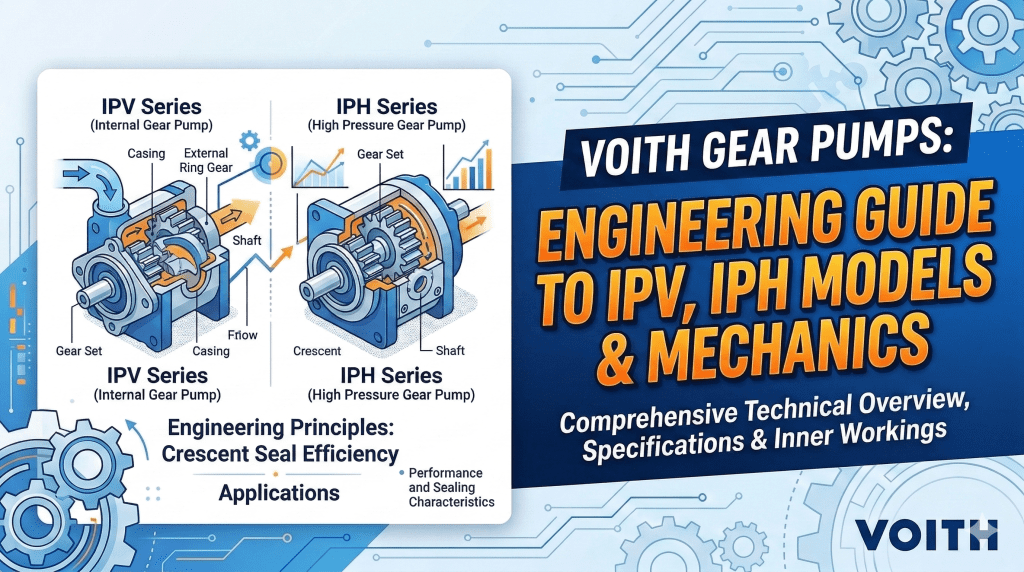
The global industrial machinery landscape is currently undergoing a profound transformation, driven by an escalating demand for energy efficiency, precise actuation, and extended operational lifespans. At the core of this mechanical ecosystem is the global hydraulic pumps market, which was valued at USD 11.53 billion in 2025 and is projected to expand to USD 16.35 billion by 2034, registering a compound annual growth rate (CAGR) of 3.95%. Within this rapidly expanding sector, positive displacement pumps serve as the critical interface between primary electrical movers and immense hydraulic forces. Among the various architectures available to fluid power engineers, internal gear pumps have emerged as the definitive solution for applications demanding exceptionally high volumetric efficiency, negligible pressure pulsation, and minimal acoustic emissions.
At the vanguard of this highly specialized engineering domain is the Voith Group. Voith gear pumps have established a dominant market presence across highly demanding industrial sectors, ranging from plastics injection molding and heavy metallurgical processing to marine engineering and power generation. In a market where traditional external gear and vane pump designs frequently struggle with fluid slippage and mechanical wear at extreme pressures, Voith’s proprietary radial and axial gap compensation technologies provide unparalleled operational advantages, allowing their systems to sustain peak pressures of up to 420 bar.
This exhaustive research report delivers a meticulous analysis of Voith gear pumps. It dissects the fundamental fluid mechanics and thermodynamics of internal gear systems, elaborates extensively on Voith’s proprietary gap compensation engineering, and details the complete taxonomy of Voith pump models—including the IPV, IPH, IPS, and IPC series. Furthermore, the analysis evaluates the comparative advantages of internal versus external gear architectures, explores complex industrial field applications, outlines rigorous lifecycle maintenance protocols, and investigates the evolving B2B search engine optimization (SEO) and digital procurement landscape that governs the modern fluid power market.
Fundamental Fluid Mechanics: How Does an Internal Gear Pump Work?
To fully appreciate the engineering superiority of Voith gear pumps, it is first necessary to establish the baseline fluid dynamics, mechanical principles, and kinematic operations governing internal gear pump architecture. An internal gear pump is a distinct classification of rotary positive displacement pumps, explicitly designed to move both highly viscous and non-viscous fluids in a highly controlled, precise, and non-pulsating manner.
Unlike centrifugal dynamic pumps, which rely on the kinetic conversion of fluid velocity to pressure and are subsequently highly sensitive to system backpressure, internal gear pumps displace a fixed, theoretical volume of fluid per mechanical revolution. This ensures a constant flow rate regardless of varying downstream resistance.
The Core Mechanical Architecture
The internal gear pump architecture is defined by a minimal number of moving parts, primarily consisting of two rotating elements housed within a precision-machined stationary casing. This simplicity belies a highly complex fluid transfer mechanism. The primary components include:
- The Rotor (Internal Gear): This is the larger, outer gear component, which features internally cut involute teeth. It is mounted eccentrically (off-center) relative to the main pump casing and is typically driven directly by the input drive shaft, which is coupled to an electric motor or an internal combustion engine.
- The Idler (External Gear): This is the smaller, inner gear. It features externally cut teeth and is mounted on a fixed stationary shaft (the idler pin) attached to the pump’s front cover plate or head. The idler nests inside the rotor, and its external teeth mesh directly with the internal teeth of the rotor.
- The Crescent Divider: Because the rotor and idler are mounted on different, eccentric axes, a void inherently exists opposite the point where their teeth fully mesh. A stationary, crescent-moon-shaped divider is machined into the pump head and sits within this void. The crescent acts as a critical mechanical and hydraulic seal, effectively separating the low-pressure suction zone from the high-pressure discharge zone.
The Three-Phase Kinematic Pumping Cycle
The continuous transfer of fluid through an internal gear pump occurs in three distinct kinematic phases. This continuous, overlapping action generates a smooth, laminar flow that is virtually free of the destructive pressure spikes and hydraulic shock (water hammer) characteristic of reciprocating piston or diaphragm pumps.
Phase 1: The Suction and Expansion Phase (Inlet) As the primary drive shaft rotates the outer rotor gear, the mechanical linkage simultaneously drives the inner idler gear. At the inlet port of the pump, the meshed teeth of the rotor and the idler begin to separate and unmesh. As these teeth pull apart, they create a rapidly expanding physical cavity. According to the principles of fluid dynamics and Boyle’s Law, this localized increase in volume leads to an instantaneous drop in pressure, creating a partial vacuum. This low-pressure zone actively draws the hydraulic fluid, oil, or process medium into the pump casing, filling the expanding spaces between the gear teeth. This powerful vacuum generation grants the internal gear pump excellent self-priming capabilities, even when drawing heavy, viscous fluids from a lower reservoir.
Phase 2: The Trapping and Transfer Phase Once the fluid fills the cavities between the gear teeth, the continued rotation of the gears carries the fluid circumferentially away from the suction port. The fluid becomes trapped in isolated volumetric pockets formed by the gear teeth on one side and the stationary crescent divider on the other. The precision-machined crescent ensures that fluid cannot slip backward toward the low-pressure zone. During this phase, the fluid travels in two parallel, isolated paths: one path along the inner diameter of the crescent (carried by the idler gear’s teeth) and another path along the outer diameter of the crescent (carried by the rotor gear’s teeth). It is critical to note that during this transfer phase, the volume of the trapped pockets remains constant; therefore, no actual pressurization of the fluid occurs within the pump casing itself.
Phase 3: The Discharge and Volumetric Collapse Phase (Outlet) As the rotating gears travel past the termination point of the crescent divider, they approach the discharge port. Here, the eccentric geometry forces the external teeth of the idler gear to begin meshing seamlessly back into the internal cavities of the rotor gear. This mechanical meshing action drastically and continuously reduces the available volume within the gear pockets, effectively collapsing the cavities. Because hydraulic fluid is essentially an incompressible medium, the fluid cannot be squeezed; instead, it is forcefully expelled from between the teeth and pushed out through the discharge port into the external hydraulic circuit. The ultimate system pressure generated at the discharge port is not dictated by the pump itself, but rather by the downstream restriction, workload, and resistance of the entire hydraulic system.
The Voith Engineering Paradigm: Advanced Radial and Axial Gap Compensation
While the foundational internal gear pump design is highly reliable and structurally sound, traditional iterations suffer from a debilitating fluid dynamic phenomenon known as “slippage.” Slippage refers to the internal leakage of high-pressure fluid from the discharge zone back to the low-pressure suction zone through the microscopic mechanical clearances between the rotating gears, the stationary crescent, and the casing walls. As fluid viscosity decreases (due to temperature increases) or as external system pressure demands rise, slippage accelerates exponentially, drastically reducing the pump’s volumetric efficiency and generating excess heat.
Voith has engineered proprietary, highly sophisticated thermodynamic and mechanical solutions to overcome this fundamental limitation, unequivocally establishing its pumps as the premier choice for high-pressure industrial hydraulics capable of sustaining up to 420 bar. This is achieved through dynamic radial and axial sealing gap compensation mechanisms.
Dynamic Axial Sealing Gap Compensation
In a standard, uncompensated gear pump, the axial clearance—the microscopic space between the flat lateral faces of the gears and the side walls of the pump casing—must be mathematically large enough to allow free rotation without metal-to-metal galling or seizure. However, it must be small enough to prevent fluid bypass. Under extreme industrial pressures, the pump casing can elastically deflect, inadvertently increasing this gap and allowing massive slippage.
Voith internal gear pumps circumvent this by utilizing dynamic axial plates (or axial discs) to seal the pressure chamber. Instead of relying on static, machined clearances, Voith’s engineering routes a highly controlled, minute amount of high-pressure fluid directly behind these axial plates. This creates an active hydrostatic pressure field that actively and continuously pushes the axial plates directly against the lateral sides of the rotating gears.
- When the external system pressure is low, the hydrostatic force pushing the plates against the gears is correspondingly low, which minimizes mechanical friction, reduces heat generation, and prevents unnecessary wear.
- Conversely, when the system pressure spikes to actuate a heavy load, the hydrostatic force proportionally and instantaneously increases, pressing the plates tighter against the gears and maintaining the absolute minimal possible gap.
This self-adjusting, pressure-responsive mechanism ensures that volumetric losses are minimized across the entire pressure spectrum, resulting in exceptional overall efficiency regardless of the duty cycle.
Advanced Radial Sealing Gap Compensation
Radial leakage occurs across the outer circumference of the gears—specifically across the tips of the gear teeth as they pass the crescent divider. Voith employs distinct, proprietary radial compensation principles depending on the specific pump series and its intended pressure operating envelope:
The Sickle Principle (High-Pressure Series): Deployed primarily in the heavy-duty IPV and IPH series, the gear chambers are sealed radially by precise gear meshing and a highly optimized, dynamic filler piece (the crescent or sickle). Rather than a solid, static block of metal, the Voith design utilizes a complex multi-part assembly consisting of a filler segment carrier and a filler sealing segment. This configuration allows for micro-adjustments under hydrostatic load to maintain a hermetic radial seal against the gear tips without causing excessive friction or localized wear.
The Superlip Principle (Low-to-Medium Pressure Series): Utilized primarily in the IPN series, radial sealing is achieved through a synergistic combination of gear meshing, the pinion head, and specialized, state-of-the-art compensation inserts known as sealing lips. These resilient sealing lips are strategically located in the crown of the internal gear. A critical mechanical advantage of the Superlip principle is that the sliding speed at these sealing points is extremely low—calculated at only one-twelfth of the overall circumferential speed of the pump. This drastic reduction in relative velocity exponentially reduces component wear, extending the service life of the pump in continuous-duty applications.
Thermodynamic and Fluid Dynamic Efficiency Calculations
The tangible efficiency of these gap compensation mechanisms can be rigorously quantified mathematically. Voith provides precise standard calculations for the fluid dynamics of their systems, allowing engineers to size hydraulic circuits with absolute precision.
The actual pump flow, representing the true volumetric delivery of the unit, is calculated using the following equation:
$$Q = V_{g\text{ th}} \cdot n \cdot \eta_v \cdot 10^{-3} \text{ [l/min]}$$
Where:
- $V_{g\text{ th}}$ represents the theoretical displacement volume of the pump per single revolution, measured in cubic centimeters ($cm^3$).
- $n$ represents the rotational speed of the input drive shaft, measured in revolutions per minute (rpm).
- $\eta_v$ represents the volumetric efficiency, a dimensionless coefficient that accounts for internal slippage.
Because of Voith’s advanced gap compensation technologies, the volumetric efficiency ($\eta_v$) frequently exceeds 0.90 (90%) even at immense peak pressures. This indicates that internal slippage accounts for less than 10% of the theoretical flow, a remarkable achievement in fluid power engineering.
Furthermore, the mechanical power required from the prime mover to drive the pump is calculated as:
$$P = \frac{Q \cdot \Delta p}{600 \cdot \eta_g} \text{}$$
Where:
- $Q$ is the actual delivered pump flow in liters per minute (l/min).
- $\Delta p$ is the differential pressure (the final discharge pressure minus the inlet suction pressure), measured in bar.
- $\eta_g$ is the overall efficiency, calculated by multiplying the volumetric efficiency by the mechanical/hydraulic efficiency.
- $600$ serves as the standard mathematical conversion constant for these specific metric units.
Voith gear pumps routinely demonstrate an overall efficiency ($\eta_g$) that is 5% to 10% higher than comparable market alternatives. This directly translates into substantially lower electrical power requirements ($P$) for the exact same hydraulic output, yielding massive long-term energy savings.
Comprehensive Taxonomy of Voith Gear Pumps: Models and Specifications
To address the highly varied demands of global industrial sectors, Voith offers a diverse and highly segmented portfolio of internal gear pumps. These units are engineered to meet specific pressure thresholds, volumetric displacements, and environmental constraints. The overarching official product catalog includes the IPV, IPH, IPC, IPS, IPVA, IPVAP, IPCA, IPCAP, IPVS, and IPN series.
Single Pump Series Specifications and Baseline Characteristics
| Pump Series | Core Application Profile | Maximum Peak Pressure | Maximum Displacement Volume | Distinguishing Engineering Features |
| IPV | Standard Constant-speed Drives | Up to 345 bar | 252 cm³ / revolution | Features volume-optimized involute gearing; represents the robust standard for high-pressure stationary applications. |
| IPVS | Extreme Constant-speed Drives | Up to 420 bar | 252 cm³ / revolution | A reinforced, heavy-duty variant of the standard IPV, structurally built to withstand the absolute highest pressure demands in heavy industry. |
| IPS | Variable-speed Servo Drives | Up to 345 bar | 252 cm³ / revolution | Explicitly optimized for integration with synchronous servo motors and variable frequency drives (VFDs) for maximum energy efficiency. |
| IPH | Special Constant-speed Drives | Up to 330 bar | 126 cm³ / revolution | Designed for highly specialized machinery requiring specific mounting footprints, such as sheet-metal presses and plastics molding. |
| IPC / IPM | Medium-pressure Applications | Moderate / System Dependent | Broadly Variable | Cost-effective, high-reliability solutions tailored for mid-tier pressure circuits. |
| IPN | Low-pressure Applications | Moderate / System Dependent | Broadly Variable | Utilizes the highly wear-resistant Superlip gap compensation principle for low-pressure fluid transfer and cooling circuits. |
Deep Dive: The IPV High-Pressure Series Architecture
The IPV series represents Voith’s flagship high-pressure line and is the industry standard for robust performance. It is characterized by its internal gear principle with sleeve bearings, volume-optimized involute gearing, and a heavy-duty housing utilizing plain and hydrostatic bearings to support extreme radial and axial shaft loads. The IPV series is designed to process HLP mineral oils complying with DIN 51524 standards, operating efficiently within an ambient temperature range of -10 °C to +60 °C, and fluid temperatures up to +80 °C.
The IPV product line is meticulously segmented into distinct frame sizes (ranging from frame size 3 to 7), each engineered to cover a specific spectrum of continuous operation parameters and volumetric displacements :
- IPV Frame Size 3 (Models 3.5 to 10): Engineered for smaller, high-speed applications. Displacement ranges from 3.6 to 10.2 cm³/rev. It accommodates a maximum input speed of 3,600 rpm and supports continuous operational pressures of 330 bar.
- IPV Frame Size 4 (Models 13 to 32): A versatile mid-range unit. Displacement ranges from 13.3 to 32.6 cm³/rev. Maximum operational speeds vary between 2,800 and 3,600 rpm based on exact displacement. Supports continuous pressures between 250 and 330 bar.
- IPV Frame Size 5 (Models 32 to 64): Designed for standard heavy industrial actuation. Displacement ranges from 33.1 to 64.9 cm³/rev. Maximum speeds range between 2,200 and 3,000 rpm. Continuous pressure is rated between 230 and 315 bar.
- IPV Frame Size 6 (Models 64 to 125): A massive high-volume pump. Displacement ranges from 64.1 to 126.2 cm³/rev. Due to the larger rotating mass, maximum speeds are restricted to 1,800 to 2,600 rpm. Continuous pressure is rated between 210 and 300 bar.
- IPV Frame Size 7 (Models 125 to 250): The largest standard unit, built for massive fluid displacement. Displacement ranges from 125.8 to an immense 251.7 cm³/rev. Maximum speeds are limited to 1,800 to 2,200 rpm. Continuous pressure is rated between 210 and 300 bar.
(Note: While these represent continuous pressure ratings, Voith specifies that peak pressures—up to 345 bar for smaller models—are permissible for up to 15% of the total operating time, assuming a maximum cycle duration of 1 minute.)
Modular Engineering: Multi-Flow Pumps and Combinations
A defining characteristic of Voith’s fluid power engineering strategy is extreme modularity. Single pump units can be mechanically coupled in a tandem arrangement via specialized intermediate housings and spline couplings to form multi-flow or multi-circuit pumps. Astoundingly, up to five distinct pumps can be joined sequentially and driven by a single input drive axis.
This modularity is absolutely crucial for complex industrial machinery that requires multiple independent hydraulic circuits running at entirely different pressures and flow rates simultaneously. For instance, a primary high-pressure IPV pump can be combined with a medium-pressure IPC pump and a low-pressure IPN pump (used for oil cooling or filtration loops). When engineering these combinations, fundamental torque distribution laws dictate that the pump with the highest flow displacement must be positioned closest to the drive motor to prevent shearing of the secondary coupling shafts.
Deciphering the Voith Alphanumeric Order Code System Voith utilizes a strict, highly descriptive alphanumeric code to define complex pump configurations. Understanding this nomenclature is essential for procurement and engineering specification. Consider a hypothetical multi-flow pump labeled IPV/N 7/5 - 200/80 111 :
- Prefix (IPV/N): Denotes a multi-flow combination consisting of a primary IPV (high pressure) pump and a secondary IPN (low pressure) pump.
- Frame Size (7/5): Refers to the physical frame sizes. Pump 1 is a massive size 7; Pump 2 is a size 5.
- Displacement (200/80): Denotes the specific volumetric delivery. Pump 1 delivers 200 cm³/rev; Pump 2 delivers 80 cm³/rev.
- Mechanical Specifications (111): The trailing digits signify precise mechanical attributes. Drawing from the IPH catalog code (
IPH 5 – 50 1 0 1), these digits sequentially represent the direction of rotation and suction port configuration (e.g., ‘1’ for clockwise rotation with radial suction), the mounting flange standard (e.g., ‘0’ for SAE 2-hole), and the shaft end type (e.g., ‘1’ for a parallel shaft with a keyway).
The Strategic Advantages of Voith Gear Pumps in Industrial Systems
The widespread adoption of Voith gear pumps in highly critical, capital-intensive industrial applications is not merely a matter of preference; it is driven by several distinct operational and thermodynamic advantages that directly impact the profitability, safety, and compliance of manufacturing facilities.
Exceptional Acoustic Performance and Occupational Safety
Heavy industrial hydraulic systems are notoriously loud, frequently exceeding safe occupational decibel limits and presenting severe hazard compliance challenges. Traditional external gear pumps and piston pumps are particularly noisy due to the abrupt, violent trapping and releasing of high-pressure fluid volumes. Because Voith internal gear pumps feature exceptionally smooth-running gears with volume-optimized involute gearing, the transition of fluid from the suction zone to the discharge zone is extraordinarily smooth.
This meticulous fluid handling results in remarkably low operating noise levels. Voith pumps routinely achieve acoustic emissions as low as 45 dB(A) under heavy load. This whisper-quiet operation often eliminates the need for expensive, space-consuming secondary acoustic enclosures or sound-dampening barriers, improving facility ergonomics and safety.
Minimal Flow Ripple and Pressure Pulsation
In high-precision manufacturing applications, such as metallurgical drawing, aerospace component pressing, or heavy robotics, hydraulic pressure pulsations (often referred to as flow ripple) are highly destructive. These pulsations cause high-frequency micro-vibrations in hydraulic cylinders, which can ruin delicate surface finishes, induce metal fatigue in piping, and damage expensive tooling. The continuous, overlapping collapsing of the fluid cavities in Voith’s internal gear design generates an almost perfectly laminar flow. This ensures extremely stable pressure characteristics, virtually eliminating pulsation and allowing for highly precise, micrometer-level control of hydraulic actuators.
Integration with Servo Pump Systems: The Energy Efficiency Revolution
Conventional industrial hydraulic systems traditionally utilize fixed-displacement pumps driven by constant-speed asynchronous motors. In such legacy architectures, the pump runs at 100% full capacity continuously. When the machine cycle does not require full flow—such as during the extended holding phase of a heavy press—the excess pressurized fluid is simply dumped over a proportional relief valve back to the reservoir. This inherently flawed design generates massive energy waste, converting electrical power directly into useless thermal energy (heat), which then requires further energy expenditure to cool via heat exchangers.
Voith has engineered the IPS series and complete integrated Servo Pump drives to revolutionize this dynamic and decarbonize hydraulic power. A Voith servo pump system represents a holistic integration of three components: a synchronous servo motor, a highly responsive variable frequency drive (VFD), and the Voith internal gear pump.
- The advanced digital control system precisely matches the pump’s rotational speed ($n$) to the exact hydraulic volume and pressure required by the machine cycle at any given millisecond.
- During part-load ranges, cooling phases, or holding phases, the servo pump decelerates drastically or stops rotating entirely, consuming near-zero energy.
- Despite this, the highly dynamic drive features incredibly fast impulse responses, meaning it can instantaneously ramp up from a dead stop to maximum pressure in milliseconds when the cycle demands it.
By converting electrical energy directly into necessary hydraulic energy on-demand, this architecture allows engineers to eliminate or drastically reduce the use of classic, highly restrictive control valves. The resulting energy savings are profound: total energy consumption can be reduced by an astounding 70% compared to traditional fixed-speed systems. Consequently, the Total Cost of Ownership (TCO) for the entire hydraulic system is reduced by up to 35%, and the initial capital expenditure for upgrading to the servo system is typically amortized within a highly favorable timeframe of 1 to 2 years.
Comparative Fluid Dynamics: Internal vs. External Gear Pumps
Fluid power engineers frequently face the critical decision of specifying either an internal gear pump or an external gear pump for a specific hydraulic circuit. While both fall under the broad category of positive displacement rotary pumps, their fundamental structural differences dictate vastly different performance profiles, limitations, and optimal application arenas.
| Engineering Feature | Internal Gear Pump Architecture (e.g., Voith IPV Series) | External Gear Pump Architecture (e.g., Bosch Rexroth AZPF Series) |
| Mechanical Mechanism | An outer driven rotor meshes with an inner eccentric idler gear, mechanically separated by a stationary crescent divider. | Two identical, externally meshing gears operating side-by-side, supported by separate, parallel shafts. |
| Volumetric Efficiency Profile | Highly efficient at low to medium rotational speeds; features minimal leakage due to advanced gap compensation mechanisms. | Better efficiency at higher rotational speeds; highly prone to volumetric slippage at low speeds. |
| Pressure Capabilities | Capable of sustaining extremely high continuous pressures (up to 420 bar for specialized models like the Voith IPVS). | Capable of high pressure (typically up to 280 bar), but generally lower than premium internal gear models. |
| Fluid Viscosity Handling | Excels with highly viscous fluids (e.g., heavy resins, syrups, high-temp oils) providing gentle, low-shear handling. | Best suited for low-to-medium viscosity fluids. May struggle to draw highly viscous media and can shear delicate fluids. |
| Acoustics and Pulsation | Exceptionally quiet (capable of 45 dB(A)); generates a smooth, virtually zero-pulsation laminar flow. | Inherently much noisier due to gear trapping; generates a higher, more destructive pressure ripple. |
| Cost and Physical Footprint | Higher initial capital expenditure due to complex, meticulous internal design; typically requires a larger physical footprint. | Highly cost-effective and mass-produced; features a very compact, robust, and lightweight housing. |
| Self-Priming Capabilities | Possesses excellent self-priming capabilities, maintaining prime even with varying system pressures and high viscosities. | Features limited self-priming ability, especially when attempting to draw thin, low-viscosity solvents initially. |
While external gear pumps (such as the Rexroth AZPF or Parker GP1) are ubiquitous in mobile construction machinery, agricultural tractors, and basic log splitters due to their low cost, high-speed capability, and compact size , they represent a compromise. Voith internal gear pumps are the definitive, uncompromised choice for heavy industrial, stationary applications requiring immense torque, whisper-quiet operation, multi-decade service life, and hyper-precise metering under immense continuous pressures.
Industrial Applications and Field Performance Case Studies
Voith gear pumps are not merely theoretical marvels; they are deployed across a diverse, globally distributed array of heavy industries, including mechanical engineering, metal processing, deep-shaft mining, petrochemicals, and municipal power generation. Examining specific field applications and documented case studies highlights the transformative financial and operational impact of integrating this advanced fluid power technology.
Plastics Injection Molding Presses: The Energy Matrix
The global plastics manufacturing sector operates on incredibly thin margins, where cycle times and electrical overhead directly dictate facility profitability. Voith pumps are predominantly utilized in this sector to actuate the immense clamping forces required to hold injection molding dies closed under extreme injection pressures.
A direct, documented comparative analysis of injection molding machine cycles reveals staggering differences in hydraulic system architectures and their subsequent energy draws :
| Hydraulic System Architecture | Pump Technology | Prime Mover | Control Methodology | Relative Energy Consumption |
| Legacy / Baseline | Fixed Displacement Pump | Constant Speed Asynchronous Motor | Complete reliance on classic proportional and directional valves. | 100% (Baseline) |
| Transitional Upgrade | Variable Displacement Pump | Constant Speed Asynchronous Motor | Partial use of classic valves. | 70% |
| Advanced Voith System | Voith Servo Pump (IPS) | Variable Speed Synchronous Servo Motor | Partial or total servo pump control, bypassing classic valves. | 30% |
Implementing the advanced Voith system not only slashes energy consumption by 70%, but also ensures highly process-safe operation with optimally controlled movement profiles, representing a massive paradigm shift in manufacturing economics.
Paper and Tissue Mills: Total Roll Management and Uptime Optimization
In the high-speed paper manufacturing industry, extreme continuous reliability is the paramount metric, as unexpected machine downtime is routinely calculated in tens of thousands of dollars per hour. Voith is deeply integrated into the paper industry, providing not just hydraulic pumps, but comprehensive, integrated technological ecosystems.
In a highly publicized case study, a high-capacity tissue mill was experiencing severe mechanical failures, specifically main bearing spinning on the tending side journals of their massive suction pressure rolls. These failures necessitated the destructive removal of expensive bearings. Through Voith’s Total Roll Management (TRM) strategic partnership, engineers diagnosed the inadequate legacy systems and replaced them with holistically designed Voith-engineered solutions.
- At the core of the upgrade, Voith installed the HydroSeal system, an innovative fluid-dynamic device designed to precisely lubricate the seal strips inside suction pressure rolls. The complex internal fluid dynamics and exact pressure delivery of these systems rely implicitly on continuous, ultra-reliable pumping.
- The implementation of the HydroSeal system was a resounding success, reducing the mill’s massive water consumption by an astounding 75% and cutting the electrical drive load energy by over 1%.
- Coupled with the installation of MegaSoft and SolarSoft proprietary roll covers (which utilize an advanced polymer matrix to provide a bonding strength four times greater than older legacy systems), the mill saved approximately $50,000 annually purely by eliminating the destructive bearing removals, while simultaneously achieving its highest production capacities to date.
Heavy Press Drives and the Future of E-Mobility
Voith’s high-pressure internal gear pumps also form the hydraulic heart of highly advanced, self-contained servo drives, such as the CLDP and PDSC systems. The PDSC hydraulic press drive, utilizing variable-speed IPS internal gear pumps, is capable of generating an astonishing maximum press force of up to 10,000 kN without relying on restrictive classic control valves.
Furthermore, anticipating the future of manufacturing, the IPS series is explicitly engineered to be fully compatible with Industry 4.0 and Industrial Internet of Things (IIoT) paradigms. The pump housings are meticulously prepared to integrate advanced sensor technology, allowing for real-time condition monitoring, predictive maintenance modeling, and seamless communication across complex automation networks.
Lifecycle Management, Maintenance Protocols, and Tribology
Despite their highly sophisticated internal geometries and extreme pressure capabilities, Voith internal gear pumps are highly regarded by maintenance engineers for their relative simplicity, possessing essentially only two primary moving parts (the rotor and the idler) within the fluid stream. However, preserving the microscopic clearances essential for the radial and axial gap compensation mechanisms requires rigorous, uncompromising adherence to fluid purity standards and strictly scheduled maintenance intervals.
Tribology, Fluid Purity, and Abrasive Handling
Internal gear pumps, by their very design, handle abrasive solids poorly. Because the axial and radial gap compensation mechanisms rely on exceptionally tight, hydrostatically maintained tolerances, the presence of suspended solids, metallic shavings, or abrasives in the hydraulic fluid can severely score the gear teeth, the internal casing, and the delicate axial plates. This scoring creates permanent bypass channels, leading to severe, irreversible volumetric efficiency degradation.
- To combat this, Voith mandates a strict fluid purity level in accordance with the NAS 1638 Class 8 standard.
- System filtration must be robust, maintaining a minimum filtration quotient of $\beta_{20} \ge 75$. However, to maximize the pump’s service life and protect the capital investment, a finer filtration standard of $\beta_{10} \ge 100$ is highly recommended.
- From a thermodynamic standpoint, the pumps are engineered to accommodate a broad fluid viscosity range of 10 to 100 mm²/s (cSt) during normal operation, with a permissible cold-start viscosity spike of up to 2,000 mm²/s. Fluid temperatures must be strictly maintained between -20 °C and +80 °C via adequate heat exchangers to prevent the thermal breakdown of the lubricating oil film, which would lead to catastrophic metal-to-metal contact.
Standardized Maintenance Schedules and Diagnostics
To prevent catastrophic operational failures, such as bearing seizure or gear shattering, Voith recommends a rigorous, tiered maintenance approach for all high-performance fluid power units :
| Operational Interval | Inspection Classification | Critical Service and Diagnostic Activities |
| 4,000 hrs / 3-6 months | Routine Preventative Check | Execute a comprehensive laboratory oil analysis to detect microscopic particulate wear metals; visually verify the preservation and readiness of critical spare parts. |
| 8,000 hrs / 1 year | Minor Technical Inspection | Visually inspect the gearbox interior, focusing on gear toothing and contact wear patterns; verify housing alignment tolerances; re-torque all bolted connections; conduct functional testing of all electronic instrumentation; replace all hydraulic oil filters. |
| 20,000 hrs / 2-3 years | Major Overhaul Inspection | Perform all minor inspection tasks, plus: comprehensive visual and micrometer inspection of plain and hydrostatic journal bearings; precise measurement of all internal mechanical clearances; laser alignment checks of input and output drive shafts. |
Common troubleshooting scenarios encountered in the field generally revolve around three primary symptomatic issues: severe bearing damage (which emits distinct acoustic grinding and requires immediate operational shutdown and replacement), excessively high lube oil temperature (which indicates a failure in the system’s heat exchanger or excessive fluid bypass generating thermal energy), and abnormally low lube oil pressure (which strongly points to external system leaks or advanced internal pump wear).
Rapid remediation of these issues is facilitated by advanced digital tools like the Voith Turbo Webshop. This digital platform is designed to integrate directly into a corporation’s Enterprise Resource Planning (ERP) systems, allowing maintenance engineers to instantly access interactive exploded CAD drawings, monitor real-time global inventory levels, and execute automated ordering of wear parts with 24/7 transparency, drastically reducing machine downtime.
Conclusion
The Voith suite of internal gear pumps—comprehensively spanning the high-pressure IPV and IPH series, the variable-speed IPS series, and the medium-to-low pressure IPC and IPN series—represents an absolute masterclass in modern fluid power engineering. By systematically and innovatively addressing the inherent thermodynamic and mechanical limitations of traditional rotary pumps, Voith has developed a scalable architecture capable of sustaining extraordinary continuous pressures (up to 420 bar) while simultaneously maintaining volumetric efficiencies well in excess of 90% and acoustic profiles as astoundingly low as 45 dB(A).
The proprietary, dynamic implementation of radial gap compensation (achieved via the highly engineered Sickle and Superlip principles) and hydrostatically driven axial sealing plates ensures that these pumps operate with near-zero internal fluid slippage. This generates the exceptionally smooth, laminar, and pulsation-free flow absolute demanded by highly sensitive, multi-million dollar industrial manufacturing processes.
Furthermore, Voith’s seamless integration of these advanced pumps into highly dynamic, variable-speed servo systems demonstrates a highly proactive, industry-leading response to urgent global demands for industrial decarbonization, lower overhead costs, and extreme energy efficiency. By offering up to 70% reductions in electrical energy consumption compared to legacy hydraulic systems, these units rapidly amortize their capital cost while fundamentally improving the operational capabilities of the machinery they power. In a global fluid power market projected to rapidly exceed $16 billion by 2034, and navigated by highly specific, intent-driven digital procurement engineers, Voith gear pumps remain the definitive, uncompromised benchmark for reliability, precision, and economic efficiency in heavy hydraulic engineering.