


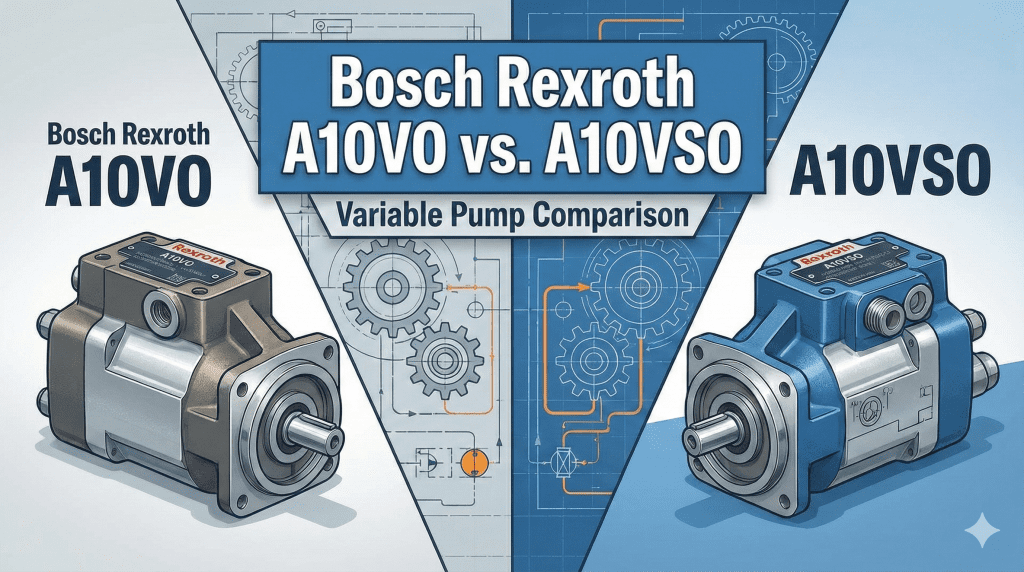
1. Executive Introduction to Medium-Pressure Axial Piston Technology
The selection of hydraulic power generation components is the cornerstone of system reliability, efficiency, and longevity. Within the domain of medium-pressure open-circuit hydraulics, the Bosch Rexroth A10 series stands as the ubiquitous industry standard. However, a persistent ambiguity exists regarding the precise technical delineation between its two primary variants: the A10VO and the A10VSO. While these two units share a common lineage, identical displacement geometries, and a nominal pressure rating of 280 bar, they represent divergent engineering philosophies tailored to distinct operational environments.
The A10VO (Variable, Open, Mobile) is the ruggedized workhorse, engineered to withstand the harsh dynamic loads, thermal shocks, and contamination risks inherent to mobile machinery such as excavators, forestry harvesters, and agricultural tractors. Conversely, the A10VSO (Variable, Stationary, Open) is the precision instrument of the industrial sector, optimized for the low-noise, continuous-duty, and electronically integrated requirements of manufacturing plants, plastic injection molding, and stationary hydraulic power units (HPUs).
This report provides an exhaustive, forensic-level comparison of these two critical components. It moves beyond superficial catalog data to explore the tribological, mechanical, and fluid-dynamic distinctions that define their operational envelopes. By analyzing bearing life theories, control architectures, and acoustic signatures, this document aims to equip system architects and maintenance engineers with the insights necessary to optimize selection and mitigate the risks of improper interchangeability.
2. Decoding the Nomenclature: The Semantics of “O” and “SO”
To understand the engineering divergence, one must first dissect the model code, which serves as the DNA sequence for the pump’s configuration. The nomenclature used by Bosch Rexroth is not arbitrary; it encodes the specific design intent and permissible operating boundaries of the unit.
2.1 The Type Code Breakdown
The generic structure for the series is A10V(S)O. The presence or absence of the letter “S” is the primary discriminator.
- A: Axial Piston Unit.
- 10: Series Number (The A10 platform).
- V: Variable Displacement (Swashplate design).
- S: Stationary Application (Industrial). If this letter is missing, the default is Mobile.
- O: Open Circuit Operation.
Therefore:
- A10VO: Optimized for Mobile Hydraulics.
- A10VSO: Optimized for Industrial (Stationary) Hydraulics.
2.2 The Significance of Series 31 vs. Series 5x/60
The comparison is most relevant within Series 31, which acts as the interchangeable standard for both lines. However, the evolution of these pumps has led to divergent paths in later series:
- Series 31: The common ground where A10VO and A10VSO share the most physical similarities, including housing dimensions and port layouts.
- Series 52/53: Specifically developed for the A10VO (Mobile) to offer higher power density and speed capabilities required by modern Tier 4/Stage V diesel engines.
- Series 60 (eOC): The latest evolution for the A10VO, integrating electronic Open Circuit (eOC) architecture to shift control complexity from hardware to software, enabling variable control modes essential for autonomous mobile machinery.
Table 1: Nomenclature and Application Matrix
| Feature | A10VO (Mobile) | A10VSO (Industrial) |
| Designation | Mobile Hydraulics | Stationary/Industrial Hydraulics |
| Circuit Type | Open Circuit (Reservoir Suction) | Open Circuit (Flooded/Reservoir Suction) |
| Primary Series | 31, 52, 53, 60 | 31, 32 |
| Nominal Pressure | 280 bar (4000 psi) | 280 bar (4000 psi) |
| Peak Pressure | 350 bar (5100 psi) | 350 bar (5100 psi) |
| Standard Mounting | SAE (2-bolt/4-bolt) Dominant | ISO/DIN & SAE Available |
3. Mechanical Architecture and Tribological Design
The most critical differentiation between the A10VO and A10VSO lies deeply buried within the housing: the bearing configuration and the rotary group design. These internal components dictate how the pump handles external physical loads transmitted through the drive shaft, a factor that is frequently the root cause of catastrophic failure when the wrong unit is applied.
3.1 The Physics of Drive Shaft Loading
In hydraulic applications, the method of connecting the prime mover (engine or motor) to the pump shaft generates specific force vectors that the pump bearings must counteract.
3.1.1 A10VO: The Radial Load Warrior
Mobile machinery often utilizes space-saving drive configurations. A diesel engine may drive the pump via a V-belt, a gear drive, or a cardan shaft (universal joint).
- Force Vector: These drive methods, particularly belt drives, exert massive radial loads (side loads) perpendicular to the shaft axis. The tension required to prevent belt slippage pulls the shaft sideways.4
- Bearing Solution: The A10VO is engineered with heavy-duty bearings—often tapered roller bearings or reinforced cylindrical roller bearings—specifically sized to withstand these high radial forces alongside the axial forces generated by the internal piston pressure.
- Data Insight: For a Size 28 A10VO, the permissible radial force ($F_q$) can be as high as 1200 N, and for a Size 100, up to 2300 N.4 This capability allows the A10VO to survive in engine compartments where the pump also serves as a tensioner or is driven indirectly.
3.1.2 A10VSO: The Axial Specialist
Industrial applications typically employ electric motors. The standard connection method involves a bell housing and a flexible coupling (e.g., spider or jaw coupling) connecting the motor shaft directly to the pump shaft.
- Force Vector: A properly aligned flexible coupling transmits torque but exerts negligible radial load. The primary force the bearings must withstand is the axial load resulting from the hydrostatic pressure pushing the cylinder block and pistons against the swashplate.3
- Bearing Solution: The A10VSO utilizes bearings optimized for this axial load and high rotational speeds but with limited capacity for radial side-loading.
- Implication: Installing an A10VSO in a belt-driven mobile application is a tribological error. The side load will cause edge-loading of the bearing rollers, leading to rapid spalling, heat generation, and eventual seizure of the shaft, often within hours of operation.
3.2 Rotary Group and Swashplate Design
While both units utilize a swashplate design, the internal geometry is fine-tuned for their respective duty cycles.
- A10VO (Dynamic Response): The swashplate control assembly in the A10VO is designed for rapid stroking. Mobile operations involve violent load changes—a bucket hitting a rock, a crane lifting a load. The pump must destroke instantly to prevent stalling the diesel engine. This requirement for high dynamic response ($<50ms$) often necessitates robust return mechanisms and larger control pistons.1
- A10VSO (Steady State Efficiency): Industrial cycles are often more predictable (e.g., clamp-hold-release). The A10VSO rotary group focuses on volumetric efficiency at steady speeds. The cradle bearings are hydrostatically unloaded to reduce friction and noise, a critical requirement for indoor plant environments where decibel limits are strictly enforced.1
3.3 Shaft Seal Technology and Environmental Sealing
The operating environment dictates the sealing strategy.
- Mobile Environment (A10VO): Exposure to mud, ice, salt spray, and extreme temperature cycling (-40°C to +100°C) is standard. The shaft seal on an A10VO is typically a robust FKM or NBR compound designed to maintain lip flexibility at cold start temperatures to prevent air ingress (aeration). It is also retained by a snap ring capable of withstanding case pressure spikes common in long, small-diameter drain lines found on excavators.
- Industrial Environment (A10VSO): The A10VSO typically operates in a climate-controlled plant. The standard FKM (Viton) seal is selected for chemical compatibility with aggressive industrial fluids (like HFD-U fire-resistant fluids) and long-term thermal stability, rather than extreme cold flexibility
Table 2: Bearing and Load Comparison
| Parameter | A10VO (Mobile) | A10VSO (Industrial) |
| Bearing Type | Tapered/Reinforced Roller | Cylindrical/Ball |
| Radial Load Capacity | High (Belt/Gear Drive Ready) | Low/Negligible (Direct Coupling Only) |
| Axial Load Capacity | High | High |
| Shaft Seal | High-Pressure Reinforced, Cold-Flex | Chemical/Thermal Stability Focus |
| Typical Drive | PTO, Cardan Shaft, V-Belt | Electric Motor (Flexible Coupling) |
4. Hydraulic Circuit Topography and Suction Characteristics
The behavior of the A10 series on the suction side is arguably more critical than the pressure side. Cavitation is the primary killer of hydraulic pumps, and the “O” vs. “SO” design reflects different approaches to fluid intake.
4.1 Suction Pressure Requirements
Both pumps are rated for a minimum absolute pressure at the suction port ($S$) of 0.8 bar absolute (12 psi abs).1 This implies they can operate with a slight vacuum (0.2 bar vacuum).
- Speed De-rating: It is vital to note that the maximum speed ratings listed in datasheets are valid only at 1 bar absolute (atmospheric pressure) or higher. If the inlet pressure drops to 0.8 bar, the maximum speed must be reduced to prevent cavitation.1
4.2 Application-Specific Inlet Dynamics
- A10VO (Mobile – Tank Suction): In mobile machines, the reservoir is often small, and the fluid level may change drastically as cylinders extend and retract. The pump is frequently mounted above the fluid level. The A10VO is designed with “Excellent Suction Characteristics” 3 to facilitate self-priming and handle the air entrainment common in mobile tanks.
- A10VSO (Industrial – Flooded Suction): Industrial units often benefit from “flooded suction” where the reservoir is mounted above the pump (e.g., an L-shaped tank). This ensures positive inlet pressure, allowing the A10VSO to run at higher continuous speeds without cavitation.
- Boost Pumps: For high-speed versions (e.g., A10VSO…H), an impeller or external boost pump is often required to maintain positive inlet pressure, permitting speeds up to 3900 rpm (Size 18).1
4.3 Case Drain and Siphoning Risks
Both units feature two case drain ports ($L, L_1$). The installation rule is universal but often violated: The drain line must be routed from the highest port to the tank, ensuring the case remains full.
- The Siphon Failure: In mobile applications (A10VO), pumps are often mounted high on the chassis. If the drain line dips below the pump level before entering the tank, a siphon effect can drain the pump case during shutdown. Upon restart, the bearings run dry. The A10VO housing design attempts to retain oil pockets for start-up lubrication, but correct piping is paramount.11
5. Control Theory and Implementation (The “Brain” of the Pump)
The versatility of the A10 series is defined by its modular control options. While the mechanical spool valves may look identical, their tuning (spring rates, orifice sizes) differs significantly between Mobile and Industrial applications to match the load dynamics.
5.1 Pressure Control (DR)
The DR control regulates the pump displacement to maintain a set pressure.
- Mechanism: When system pressure reaches the spring setting, the control spool opens, directing pressure to the control piston to de-stroke the pump.
- A10VSO Application: Standard for “Clamping” functions in machine tools. The pump maintains pressure at zero flow (deadhead) with minimal heat generation.
- A10VO Application: Used for fan drives or brake accumulators where a constant pressure is needed, regardless of engine speed.
5.2 Load Sensing / Pressure & Flow Control (DFR / DFR1)
This is the most complex and important distinction. The DFR control maintains a constant pressure differential (Delta P, usually 14 or 20 bar) across an external orifice (the operator’s joystick).
- DFR (Industrial Standard): The X-port (pilot signal) connects to the tank through a small orifice to bleed off signal pressure when the valve centers. This creates a constant, small parasitic flow loss (“pilot flow”). In an industrial plant connected to the electrical grid, this minor energy loss is acceptable for the sake of control stability.13
- DFR1 (Mobile Standard): In mobile equipment, fuel efficiency is paramount. The DFR1 version has the orifice between the X-channel and the tank plugged.1 This prevents continuous pilot oil loss to the tank when the controls are neutral. This “leak-free” pilot logic is essential for meeting Tier 4 Final / Stage V emission/efficiency targets for diesel engines.
- Insight: Putting a standard DFR (Industrial) pump on a mobile excavator will result in constant pilot flow loss, overheating the hydraulic fluid and wasting fuel. Putting a DFR1 (Mobile) pump on an industrial machine may cause instability or “jittery” control if the system isn’t designed to bleed trapped pilot pressure.
5.3 Power/Torque Control (DFLR)
- A10VO Focus: The torque control prevents the hydraulic pump from stalling the diesel engine. As pressure rises (digging into hard earth), the pump automatically reduces flow to keep the input torque constant. This matches the pump’s demand to the engine’s torque curve.1
- A10VSO Focus: Protects the electric motor from thermal overload. Since electric motors have a breakdown torque, the DFLR prevents the pump from exceeding the motor’s rated kilowatt limit during pressure spikes.
5.4 Electronic Control (eOC and Proportional)
The future is digital.
A10VSO Electro-Proportional (ED/ER): Widely used in injection molding to profile injection pressure curves. The solenoid directly controls the setpoint, allowing the PLC to run complex pressure cycles.
A10VO Series 60 (eOC): Bosch Rexroth’s new “electronic Open Circuit” architecture removes the hydromechanical spools entirely. Sensors measure swivel angle and pressure; a central BODAS controller calculates the required displacement. This allows the pump to switch modes (Pressure Control -> Torque Control -> Flow Control) dynamically via software, a game-changer for autonomous mobile robots.5
Table 3: Control Strategy Differences
| Control Code | Function | Mobile (A10VO) Nuance | Industrial (A10VSO) Nuance |
| DR | Pressure Cut-off | Auxiliary circuits (Fan drives) | Clamping / Holding |
| DFR | Load Sensing | Avoid. Causes parasitic loss. | Standard. Bleeds X-line for stability. |
| DFR1 | Load Sensing | Standard. Plugged X-line saves fuel. | Rare. Used if leak-free pilot is needed. |
| DFLR | Torque Limiter | Anti-Stall for Diesel Engine | Motor Overload Protection |
| eOC | Electronic Control | Dynamic mode switching (Series 60) | Integration with Industry 4.0 |
6. Acoustic Emissions and NVH Characteristics
Noise, Vibration, and Harshness (NVH) requirements are diametrically opposed in the two sectors.
6.1 The Industrial Requirement (A10VSO)
In a factory, background noise is relatively low (70-80 dBA). A hydraulic pump operating at 280 bar can easily exceed 90 dBA, becoming a health hazard.
- Design Optimization: The A10VSO features a hydrostatically unloaded cradle bearing and specialized valve plate timing (pre-compression grooves). These features soften the pressure shock as the piston transitions from the low-pressure suction side to the high-pressure output side.
- Result: Reduced structure-borne vibration and lower airborne noise levels.1
6.2 The Mobile Reality (A10VO)
A diesel excavator engine runs at 100+ dBA. The hydraulic pump noise is largely masked by the engine roar and cooling fans.
- Design Trade-off: While the A10VO is still engineered for “Low Noise” , the priority is power density and efficiency. The aggressive valve timing needed for high volumetric efficiency at variable speeds may produce a sharper acoustic signature than the A10VSO, but this is acceptable in the mobile context.
- Recent Advances: The A10VO Series 60 introduces an integrated pre-compression volume, which reduces pressure pulsation by up to 50%. This brings industrial-level quietness to the mobile cab, improving operator comfort without adding heavy insulation.
7. Fluid Compatibility, Viscosity, and Thermal Management
The interaction between the pump’s metallurgy/elastomers and the hydraulic fluid is the limiting factor for life expectancy.
7.1 Viscosity Bandwidth
- Optimum ($v_{opt}$): 16 to 36 $mm^2/s$. Both pumps perform best here.
- Cold Start (A10VO): Mobile machinery sits outside. At -25°C, ISO VG 46 oil thickens to syrup ($>1000 mm^2/s$). The A10VO is rated for intermittent cold starts up to 1600 $mm^2/s$.
- Physics: At high viscosity, the fluid cannot fill the cylinder bore fast enough (cavitation risk), and the lubricating film on the slipper pads can shear, causing “slipper lift-off.” The A10VO’s retainer plate is reinforced to handle these start-up forces.
- Hot Run (A10VSO): Industrial units run hot and continuous. If viscosity drops below 10 $mm^2/s$, the lubricating film collapses, leading to metal-on-metal contact.
7.2 Specialized Fluids
- HFD-U (Fire Resistant): Used in steel mills and die casting. These ester-based fluids attack standard NBR seals. The A10VSO is almost always spec’d with FKM (Viton) seals for this reason.
- Environmentally Acceptable Fluids (EAL): HEES (Synthetic Ester) or HEPG (Polyglycol) are required for forestry (A10VO) to prevent soil contamination. These fluids have different bulk modulus and lubricity properties. The A10VO design accounts for the lower lubricity of some biodegradable fluids compared to mineral oil.
Table 4: Fluid and Viscosity Limits
| Parameter | A10VO Limits | A10VSO Limits |
| Max Viscosity (Cold Start) | 1600 $mm^2/s$ (t < 1 min) | 1600 $mm^2/s$ |
| Min Viscosity (Short Term) | 7 $mm^2/s$ | 10 $mm^2/s$ |
| Max Fluid Temp | 115°C (local) | 90°C (drain port) |
| Standard Seals | NBR or FKM (Cold Flex) | FKM (Chem Resistance) |
| Fluid Types | Mineral, Bio (HEES) | Mineral, Fire Resistant (HFD) |
8. Installation, Commissioning, and Operational Best Practices
The phase between unboxing and full production is where 80% of premature failures are initiated.
8.1 Cleanliness and Filtration
Both units require a cleanliness level of 20/18/15 (ISO 4406) or better.
- Risk: The swashplate control piston and the DFR pilot spool have tight clearances ($<5 \mu m$). Silt particles will cause the control to stick, leading to “run-away” pressure or failure to stroke.
8.2 Air Bleeding (The Critical Step)
Air is compressible; oil is not. Air in the piston chamber causes “diesel effect” micro-explosions that pit the brass slipper shoes.
- Procedure: Before starting the prime mover, the case of the A10V(S)O must be filled with clean oil via the upper drain port. The suction line must be bled of air.
- Mobile Specific: On an A10VO, because of the complex tank geometry, air pockets can form in the suction hose loops. Vacuum bleeding is sometimes required.
8.3 Break-in Period
For the first 50 hours, the pump should not be run at peak pressure. This allows the cylinder block running face and the valve plate to “bed in,” creating a perfect mating surface.
9. Maintenance, Failure Analysis, and Troubleshooting
When an A10 series pump fails, the debris pattern tells the story.
9.1 Common Failure Modes
- Cavitation (Marbles in a Can Noise):
- Symptoms: Loud growling noise, pitting on the valve plate suction kidney.
- Cause: Clogged suction strainer, cold oil (high viscosity), or air ingress.
- Aeration:
- Symptoms: Foamy oil in the tank, erratic actuator movement.
- Cause: Shaft seal failure (sucking air) or low tank level.
- Contamination:
- Symptoms: Scored pistons, stuck control spool (pump won’t build pressure).
- Cause: Failed filter, dirty fill oil.
- Over-Speed / Over-Pressure:
- Symptoms: Slipper shoe lift-off (deformation of the retainer plate).
- Cause: DFR setting too high, or engine governor failure.
9.2 Troubleshooting Guide
- Problem: Pump delivers no flow.
- Check: Is the drive shaft turning? (Sheared key/spline?).
- Check: Is the DFR X-line connected? If the X-line is vented, the pump will standby at low pressure (~18 bar) and produce no effective flow.14
- Problem: Pump overheats.
- Check: Is the case drain flow excessive? (>10% of total flow indicates internal wear).
- Check: Is the cooler blocked?
10. Interchangeability, Retrofitting, and Supply Chain Considerations
The multi-million dollar question: “Can I use an A10VO instead of an A10VSO?” or vice-versa.
10.1 Scenario A: Using A10VO (Mobile) in an Industrial Application
- Verdict: Generally Safe.
- Pros: The A10VO is mechanically over-built for industrial loads. Bearings will last virtually forever under zero radial load.
- Cons:
- Noise: It may be louder than the specified A10VSO.
- Control: The DFR1 (plugged orifice) might need modification (drilling the orifice) if the industrial circuit expects a bleed-off.
- Shaft: Industrial motors often use Keyed shafts (P/K), while Mobile uses Splined (S/R). You may need to change the coupling.3
10.2 Scenario B: Using A10VSO (Industrial) in a Mobile Application
- Verdict: High Risk / Forbidden.
- Why:
- Bearing Failure: If the mobile drive has any side load (belt/gear), the A10VSO bearings will fail catastrophically.
- Seal Failure: The standard seal may leak during a -20°C cold start.
- Control Loss: The DFR (open orifice) will cause constant pilot flow loss, heating the oil and wasting fuel.
- Mounting: Mobile machines often require SAE 2-bolt/4-bolt; if the A10VSO has an ISO flange, it won’t fit.
10.3 Supply Chain Dynamics
- Lead Times: A10VO pumps often have longer lead times due to the massive volume required by OEM production lines (Caterpillar, etc.). A10VSO pumps are more readily stocked by distributors for single-unit industrial replacement.15
- Aftermarket: Both units have robust aftermarket support (seal kits, rotary groups). However, mixing aftermarket “Mobile” rotary groups into “Industrial” housings is a recipe for tolerance mismatch.
11. Conclusion and Strategic Recommendations
The Bosch Rexroth A10VO and A10VSO represent a masterclass in platform engineering—two distinct products derived from a single geometric core. The A10VO is defined by its robustness: its ability to handle radial loads, cold starts, and the jarring dynamics of earthmoving. The A10VSO is defined by its refinement: its quiet operation, precise control, and stability in continuous industrial processes.
Strategic Recommendations for Engineers:
- Respect the Drive: Never spec an A10VSO if there is a belt or gear drive. The radial load will kill it.
- Watch the Orifice: When swapping pumps, always check the Pilot (X) port configuration (DFR vs DFR1). A $5 orifice plug can be the difference between a perfectly running machine and an overheating nightmare.
- Standardize Where Possible: For mixed fleets, the A10VO with a splined shaft is the “safer” universal spare, provided the noise levels and control tuning are adjusted for industrial use. The reverse is not true.
By strictly adhering to these distinctions, organizations can ensure the reliability of their hydraulic assets, maximizing the “Total Operating Period” toward the theoretical 300+ hours of peak pressure life and tens of thousands of hours of service life.